
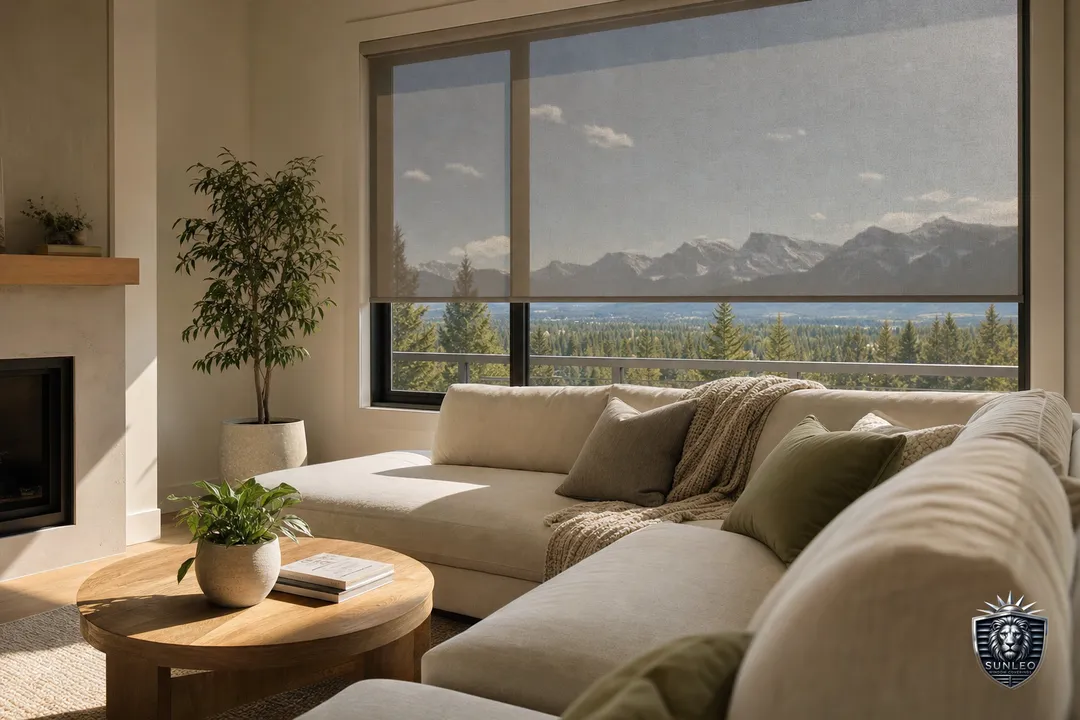
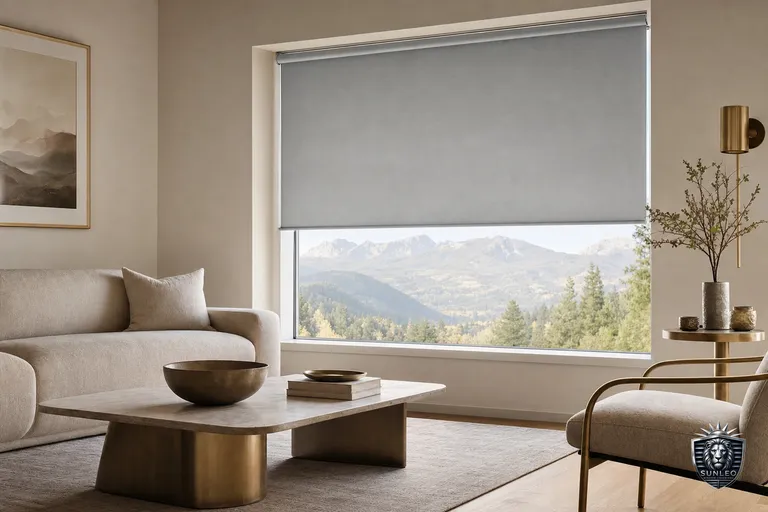
Calgary gets more bright, sunny days than almost any major city in Canada — and at over 1,000 metres of elevation, that sunshine arrives stronger and harsher than most homeowners expect. South- and west-facing windows pay the price: blinding afternoon glare on TVs and laptops, hot rooms by 4pm, and hardwood, rugs and furniture that fade season after season. The newer open-concept homes across communities like Mahogany, Livingston, Seton and Cornerstone make it worse, with floor-to-ceiling glass and wide patio sliders. Solar screen roller shades are built for exactly this. A tightly woven screen fabric filters UV, heat and glare while keeping your view of the yard, street or mountains intact — you shade the room without closing it off. Sunleo custom-makes every solar shade to your exact window, and because we're fully mobile with no showroom, we bring the full range of openness factors and screen colours to your home so you can see them in your own light before deciding.
How Openness Factor (1% to 10%) Works
Every solar shade is rated by an "openness factor" — the percentage of the fabric that is open weave versus solid yarn. It runs from about 1% to 10%, and it's the single most important choice you'll make. A 1–3% screen is tightly woven: it blocks the most UV, heat and glare, gives strong daytime privacy, and shows only a soft, hazy outline of what's outside. A 5% screen is the popular middle ground — meaningful glare and heat control while still letting you read the yard or street clearly. A 10% screen is the most open: it preserves the crispest, most detailed outward view but lets through more light and glare, so it suits rooms that are bright but not blasted by direct sun. There's a genuine trade-off: the more you can see out, the less the fabric blocks, and vice versa. The right answer depends on the window's exposure, what's behind the glass, and how much you value view versus shade. Because this is so personal, we bring physical samples in several openness factors and hold them against your actual window, at the time of day that bothers you most, so you choose by what you see — not a number on a chart.
Built for Calgary's High-Altitude Sun and Newer Builds
Calgary is one of the sunniest major cities in Canada, and its elevation — over a kilometre above sea level — means stronger UV than lower-lying cities at the same latitude. That's great for mood, hard on interiors. South- and west-facing rooms take direct sun for hours, especially the long summer evenings and the low, snow-reflected glare of winter afternoons. The result is hot, hard-to-use rooms, washed-out screens, and flooring, art and upholstery that fade prematurely. Newer Calgary builds amplify all of it: communities like Mahogany, Seton, Livingston, Cornerstone, Belmont and Wolf Willow favour open-concept layouts with large windows and wide patio doors, so there's simply more glass collecting heat and light. Solar screen roller shades are the targeted fix. They cut a large share of UV and solar heat at the window, tame glare on TVs and home-office monitors, and protect your furnishings — all without making the room dark or boxing in the view you paid for. For west-facing great rooms and south-facing kitchens, a 3–5% solar screen typically delivers the best balance of comfort and outlook. We assess each window's exposure during the in-home visit and match the openness factor to how that room is actually used.
Solar Screens on Patios, Sunrooms and Tall Sliders
Solar screens earn their keep on patios, sunrooms and tall sliding doors — the bright, glassy spaces where you want shade but never want to lose the view. On a covered deck or screened porch, a solar roller knocks down late-day glare and heat so the space stays usable through a Calgary summer evening, while you still watch the kids in the yard or the sunset over the foothills. For wide patio sliders, a single wide roller or a pair of coordinated shades keeps sightlines clean. The practical catch on these openings is reach: many newer homes have windows and transoms two or three metres up, or sliders behind furniture, that are awkward to operate by hand. That's where motorizing the solar shade matters — quiet, rechargeable or hard-wired motors let you drop every screen on the sunny side of the house at once, on a schedule or by voice with Alexa, Google Home or Matter. Grouping shades to follow the sun keeps rooms cool without you thinking about it. We measure these tricky openings precisely during the in-home visit, confirm mounting depth and clearance, and recommend manual or motorized operation based on the height, weight and how often you'll actually adjust each shade.
What Solar Shades Do — and Honestly Don't
It's worth being clear about what a solar shade does and doesn't do, because the wrong expectation leads to disappointment. During the day, solar screens are excellent: they cut glare, UV and heat, and give you privacy from outside while you keep seeing out. After dark, that flips. Once your interior lights are on and it's black outside, the same open weave that lets you see out during the day lets people see in — so a standalone solar shade is not a nighttime-privacy or blackout solution. That's how the fabric works, not a flaw, and it applies to every solar screen on the market. For living rooms, kitchens, offices and patios — spaces used mostly in daylight — a solar shade alone is usually perfect. For bedrooms, media rooms, or any window where you want darkness and privacy at night, we pair the solar screen with a second blackout roller on a dual bracket, so one window gets both: the view-friendly screen by day and full blackout by night, each on its own pull or motor. We'll flag which of your windows are daytime-only and which need that second layer during the consultation, so nothing surprises you after install.
Choosing Screen Colour: Dark vs Light
Screen colour changes how a solar shade performs, not just how it looks — so choose it deliberately. Darker screens (charcoal, bronze, black) absorb light and cut glare more effectively, giving you a sharper, higher-contrast view outside; they're the usual pick for media walls, home offices and any window where you're fighting screen glare or want the clearest outlook. Lighter screens (white, ivory, grey) reflect more solar heat away from the glass and keep a room feeling brighter and more open, but they scatter light, so the outward view is hazier and daytime glare control is a little softer. There's also a street-side consideration: from outside, lighter shades read cleaner against most newer Calgary exteriors, while darker shades tend to disappear into the glass. Many homeowners land on a darker screen where view and glare matter most and a lighter tone where heat and brightness are the priority — and you can absolutely mix colours room to room. Because daylight in your home never matches a showroom, and we don't have one anyway, we bring the colour and openness samples to you and hold them against your own windows so you can judge view, glare and warmth in the exact light you live in.