
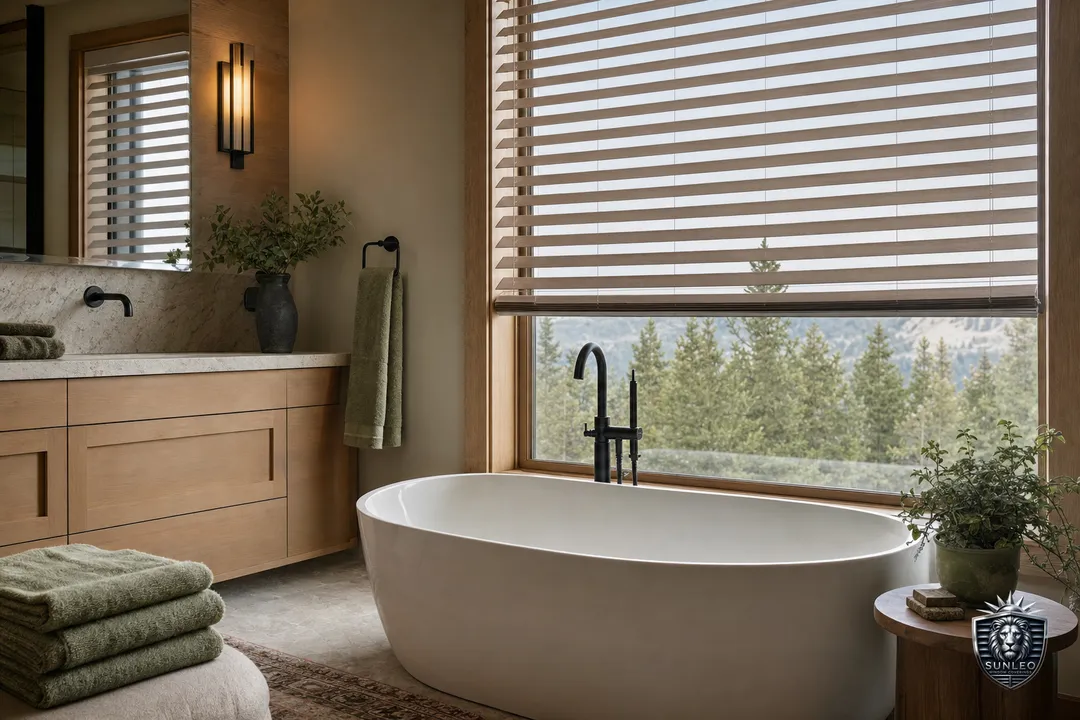



Small windows are deceptively tricky to dress. A blind that looks balanced on a big living-room window can completely overwhelm a narrow bathroom pane, a hallway slot or the little window above the kitchen sink — the headrail looks chunky, the stacked fabric eats half the glass, and the cords and brackets crowd an already-tight frame. The goal on a small window is the opposite of a large one: you want the covering to almost disappear, keep its proportions tidy, and leave as much daylight and view as the room can spare. That usually means a slim system, a shallow stack, and sometimes no operating mechanism at all. Sunleo handles this in your home, not a showroom — a specialist measures each small opening, checks the reveal depth and any handles or taps in the way, and brings real samples so you can hold a mini slat or a fabric sample against the actual glass. You get a written quote within 48 hours, with no online cart and no obligation.
Why small and narrow windows need a different approach
On a small window, every part of the blind is suddenly proportionally large. The headrail that looks slim on a patio door now reads as a heavy bar across the top; the bundle of fabric or slats that stacks when you raise the blind can cover a third of a short window even when it's fully open; and the brackets, cords and chains crowd a frame that may only be a foot or two wide. The result is a window that feels smaller and busier than it is. The fix is to think in proportion, not just in product. A narrow window wants a narrow stack and a low-profile head — a system that tucks up tight, or doesn't move at all. It often wants a cordless or no-drill mechanism so there's no operating clutter beside the glass. And it frequently wants an inside mount that sits cleanly within the reveal, framing the window rather than sitting on top of it like a shelf. The other reality of small windows is where they live: bathrooms, ensuites, hallways, stairwell landings and above the kitchen sink. Those are damp, high-reach or awkward spots where a heavy fabric blind, a long cord or a deep stack is exactly what you don't want. Matching the system to the spot — moisture-tolerant here, reach-free there, permanent privacy somewhere else — matters far more on a small window than choosing a fashionable fabric.
No-drill and mini fits for tight reveals
Small windows are often shallow, oddly framed, or in places you'd rather not drill — a tiled bathroom reveal, a uPVC casement, a rented condo. That's where no-drill and mini systems earn their keep. Perfect Fit blinds clip into a slim frame that pushes onto the rubber bead of a uPVC window — no screws, no holes, no plugs in the tile. The blind sits tight against the glass within the frame, so it takes up almost no depth and moves with the window if it's a tilt-and-turn or casement. For a small bathroom or a hallway window that has to stay tidy, that snug, built-in look is hard to beat, and it's ideal for renters who can't make holes. Mini aluminum blinds are the other workhorse here: 16mm or 25mm slats on a slim headrail fit into shallow reveals where a thicker faux-wood blind simply wouldn't clear the handle or the opening. They tilt for precise light and privacy, raise to a compact stack, and the narrow slats keep the scale right for a small pane. The honest trade-off with both is that they suit modest openings best — Perfect Fit depends on having a suitable uPVC bead to clip to, and very deep or very shallow reveals can rule an inside mount in or out. That's exactly the sort of thing a quick in-home measurement settles in two minutes: a specialist checks the bead, the depth and the handle clearance before anything is ordered.
Bathrooms and above the sink: moisture, reach and privacy
The most common small windows in any Calgary home are the steamy and the splash-prone ones — the bathroom pane and the little window above the kitchen sink — and fabric is usually the wrong answer for both. In a bathroom, a fabric roller or honeycomb shade sits in repeated humidity, and over time damp can mark or curl the cloth. Aluminum mini blinds shrug that off: the slats wipe clean, don't absorb moisture, and tilt to give you privacy while still venting steam. Above the kitchen sink the problem is splashes and reach — you're leaning over a basin and possibly a tap to operate the blind, so a wipeable surface and a cordless or short-throw mechanism beat a long dangling cord every time. A slimline roller in a PVC or moisture-tolerant fabric works well here too, raising to a tiny stack so it never blocks the view of the backyard while you wash up. And for a bathroom window where you simply want privacy and never really open the blind, a PVC roller left down is the tidiest answer: it holds the sightline, still lets daylight through, wipes clean when steam settles on it, and rolls up to almost nothing on the days you do want the glass clear. On a small obscured-glass window that only needs privacy and not light control, that is usually all it takes.
Keeping proportions right: avoiding bulky stacks
The single biggest mistake on a small window is a covering that bunches up and steals the glass. When a blind is raised, the gathered fabric or slats — the 'stack' — has to go somewhere, and on a short window that stack can swallow a surprising chunk of the view even when the blind is wide open. So the smartest small-window choices are the ones with the smallest stack. A slim roller blind wins here: the fabric wraps onto a thin tube and disappears into a neat roll at the top, leaving the glass almost entirely clear. Mini aluminum blinds stack tighter than chunky faux-wood ones because the slats are thinner. Where you do want a soft fabric look, a cellular shade in a small cell size keeps the gathered stack compact while still insulating. Mounting matters just as much as the product. An inside mount inside the reveal keeps the whole covering within the window's own frame, so it never adds visual bulk to the wall around a small window — the cleanest, most proportionate look. An outside mount can make a small window appear a little larger by extending past the opening, but only if it's done deliberately and kept slim, otherwise it just looks heavy. None of this is guesswork at a desk; it depends on your exact reveal depth, the frame, and what's in the way — which is precisely what an in-home measurement is for.
Calgary light and climate on small windows
Small windows still have to deal with Calgary's big sky. Our high-altitude sun is intense and the UV is strong, so even a modest bathroom or stairwell window can fade a towel rail, a painting or a patch of flooring over time — heavier light-filtering or dim-out fabrics help where that's a concern. The low winter sun is the sneaky one: from October to March it sits flat on the horizon and drives straight through south- and west-facing glass, and a small window at the wrong height can throw a hard, blinding stripe across a hallway or right into your eyes at the sink. A blind you can tilt or lower precisely — mini aluminum slats are excellent for this — lets you cut that low glare without blacking out the room. Chinooks bring sudden bright warm spells in the middle of winter, so the ability to adjust quickly, rather than living with a fixed treatment, is genuinely useful on the windows you pass every day. Because Sunleo is mobile-only with no showroom, all of this gets judged in your own light: a specialist sees how the sun actually hits each small window, brings samples to hold against the real glass, and recommends the fabric or slat that suits that exact spot. They confirm the measurements on site and follow up with a written quote within 48 hours, with professional installation across Calgary, Airdrie, Okotoks, Cochrane, Chestermere and Strathmore.


