
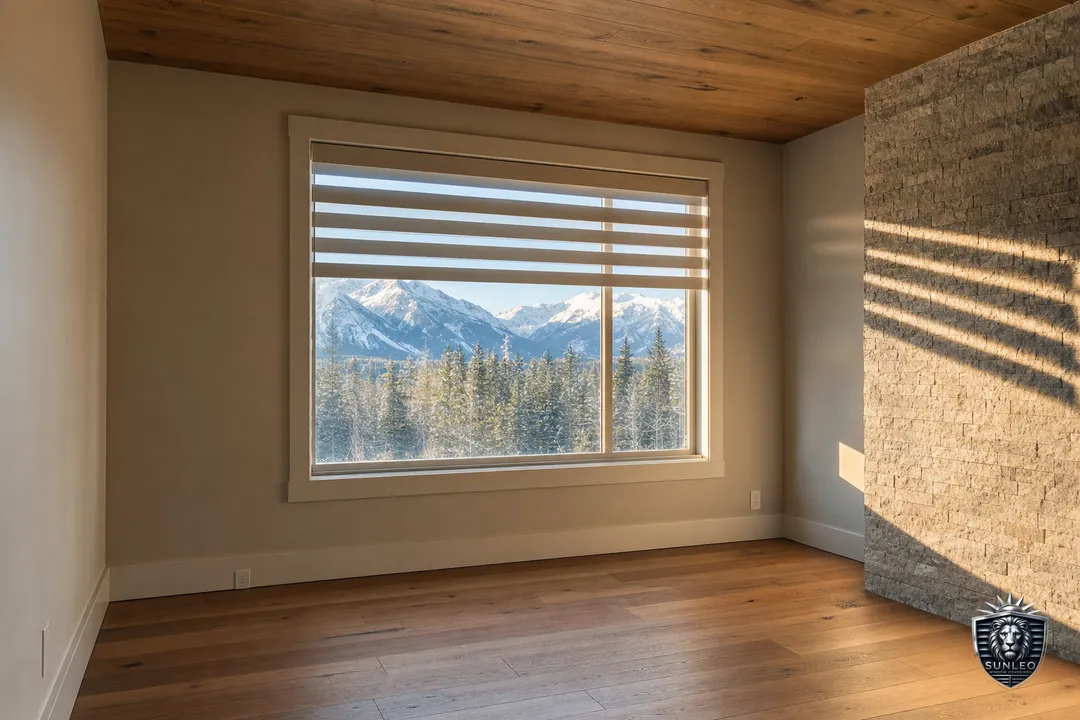
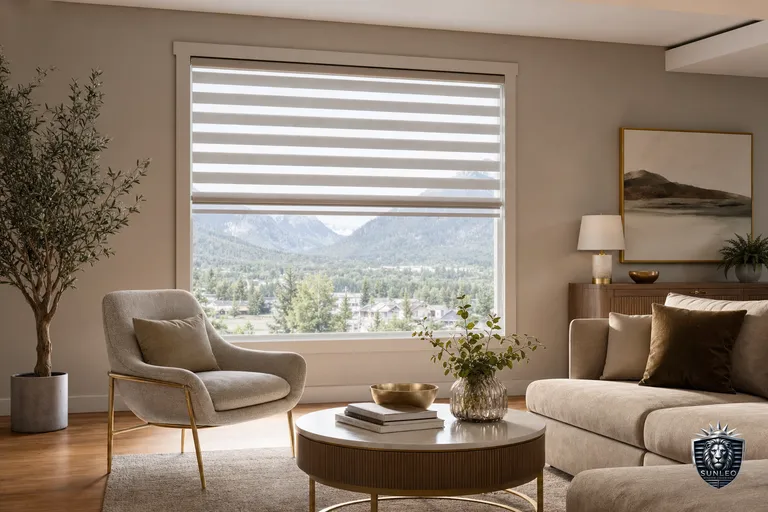
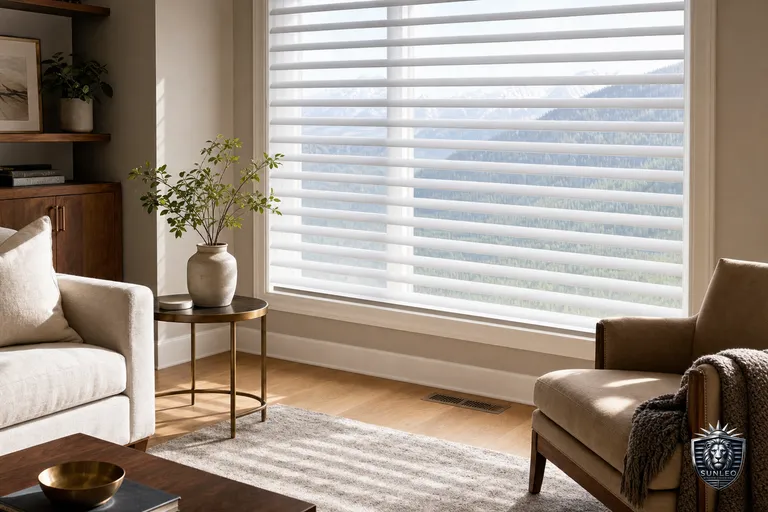
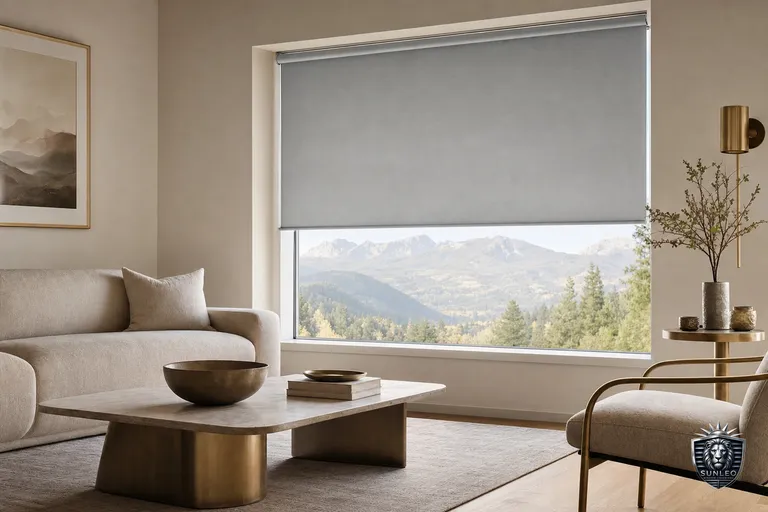
The living room is where your home is most on display — and usually where the biggest windows live. You want morning light and the mountain or yard view, but not blinding afternoon glare on the TV, faded furniture, or the feeling that the whole street can watch you at night. In Calgary that balancing act is harder than most cities: high-altitude UV is stronger than it looks, the low winter sun cuts in at a flat angle for hours, west-facing glass bakes from late afternoon, and Chinooks swing the temperature 20 degrees in a day, so insulation matters too. Sunleo is a mobile, in-home service — there's no showroom to drive to. A consultant brings real fabric and opacity samples to your living room, holds them against your actual windows in your actual light, measures everything, and you get a clear written quote within 48 hours. Below is an honest look at which living room blinds work, and where each one compromises.
Start with the window: light, view and privacy on big glass
Living room windows are rarely simple. You'll often have a large picture window, a sliding patio door beside it, and maybe transoms or an angled top. The first decision is what you most want to protect: the view, the daylight, or your privacy after dark — because no single shade maximizes all three at once.
If the view is the hero (a yard, a park, downtown, or the foothills), you want a covering that filters rather than blocks. Sheer shades and zebra (day-night) blinds shine here: in their open setting you keep a soft outward view while cutting glare, then close the vanes for privacy. The honest trade-off is that any fabric you can see out of in daytime, people can partly see into at night once your interior lights are on — that's physics, not a product flaw. For true after-dark privacy you need a separate opaque or blackout layer, or you accept closing the shade fully in the evening.
If glare on screens is the daily frustration, prioritize a light-control fabric you can lower to a comfortable level without going fully dark. A light-filtering roller, or a zebra in its closed band, knocks back harshness while keeping the room usable.
Because Calgary's winter sun sits so low, side glare from the west and southwest reaches deep into the room for hours. Plan for a covering you'll actually adjust through the day — which is exactly why so many living rooms end up motorized.
Managing Calgary sun, UV and afternoon heat
South- and west-facing living rooms are the ones that suffer most. From spring through fall, that glass becomes a solar collector: hardwood, leather, art and rugs fade, and the room overheats by dinnertime. At Calgary's elevation the UV load is higher than people expect, so fading happens faster than in lower, cloudier cities.
The most flexible answer is a zebra or sheer shade: tilt the bands open to keep the view, or close them to cut glare and UV hard. A light-filtering or dim-out roller softens the sun further but trades away the outlook while it is down. That's the core trade-off — there's no fabric that gives you a crystal view AND maximum heat rejection. If your living room cooks every afternoon, lean heavier and accept a dimmer view; if it's gently sunny, a zebra or sheer keeps it cheerful.
For rooms that genuinely overheat, honeycomb (cellular) shades are the quiet winner: the air pockets in the fabric slow heat transfer both ways — keeping summer heat out and winter warmth in during cold snaps. The honest catch is that a single cellular shade limits your view more than a sheer or zebra, so some clients pair a cellular on the worst window with a view-friendly shade elsewhere.
Chinooks add one more wrinkle: rapid warm-ups mean you'll want easy, frequent adjustment rather than a 'set it once' approach. Layering — a light-filtering shade for the day plus a heavier option for glare and cold evenings — gives you range without committing the whole window to one compromise.
Style: making the most-seen room look considered
This is the room guests see, so the covering is as much furniture as function. The good news is living rooms give you room to be intentional, because the windows are large enough to make a fabric or fold actually read as a design choice.
Roller and zebra blinds give a clean, modern, almost architectural line — great for contemporary Calgary builds, condos and minimalist spaces. They sit tight to the glass and disappear when raised. The trade-off is they're more 'crisp' than 'cozy'; if your living room leans warm, traditional or layered, a flat roller can feel a little plain on its own.
Roman shades solve that. They bring soft, tailored fabric folds and a custom, upholstered look that warms up the whole room — ideal if your space has texture, woods and softer tones. Honestly, romans cost more than a basic roller and stack a few inches of fabric at the top even when fully raised, so they reduce a little glass at the top of tall windows.
Scale matters too. On very wide picture windows, one enormous blind can look heavy and be awkward to operate; splitting into two or three coordinated shades on a shared headrail usually looks better and works more smoothly. Colour-wise, Calgary's long grey winters make warm creams, soft greiges and natural textures feel inviting; stark white can read cold. During the in-home visit you'll see samples against your own wall colour and flooring, which is the only reliable way to judge it.
Tall, wide and hard-to-reach: where motorization earns its keep
Living rooms are the room most worth automating, and it's not just a luxury argument. Big windows mean big, heavy shades; tall or stairwell windows mean some are simply out of arm's reach; and the whole point of living-room shading — adjusting through the day as the Calgary sun moves — only happens if adjusting is effortless.
Motorized blinds let you set every shade in the room to a glare-free level with one tap, schedule them to drop automatically when the afternoon sun hits the west glass, and raise at sunset for the view. They're cleaner and safer too: no cords, which matters in family rooms with kids and pets. They integrate with Alexa, Google Home and Matter, so 'living room shades down' becomes a voice command.
The honest trade-offs: motorization adds cost per window, and on a room full of windows that adds up. Rechargeable-battery motors are the easy retrofit — no wiring — but the batteries need recharging a few times a year, and very large shades draw more, so they're recharged a bit more often. Hardwired motors avoid that entirely but want planning (ideally before drywall, or accepting a bit of visible wiring). Our recommendation: motorize the windows that are genuinely hard to reach or that you'll adjust daily, and keep simple manual controls on the easy ones. You don't have to automate the whole room to get most of the benefit.
Cost, layering and how the in-home quote works
Living rooms are usually the highest-ticket room in the house simply because the windows are the largest, and price scales with size, fabric and operation. Rather than quote misleading numbers, here's what actually moves the cost: square footage of glass (big picture windows use a lot of fabric), the fabric tier (premium zebra and sheer fabrics, textured romans and blackout linings cost more than standard rollers), whether you motorize, and how many separate shades you split a wide window into.
The smartest way to control budget is to spend where it counts. Many Calgary living rooms don't need the most expensive option on every window — they need the right option on the problem window (the west-facing one that overheats) and a simpler, coordinated shade on the rest. Layering is the other lever: a light-filtering shade for daytime view plus a separate blackout or heavier panel for glare and cold winter evenings gives you full range, but it's two coverings per window, so it costs more than a single do-everything shade.
Because every living room's light, sizes and sightlines differ, an accurate price needs a real measurement — guessing online leads to ordering the wrong opacity or size. That's why Sunleo comes to you: the consultant measures every window, you compare samples in your own light against your own furniture, and you receive an itemized written quote within 48 hours with no obligation. No showroom trip, no pressure — just the numbers for the combination you actually chose.


