
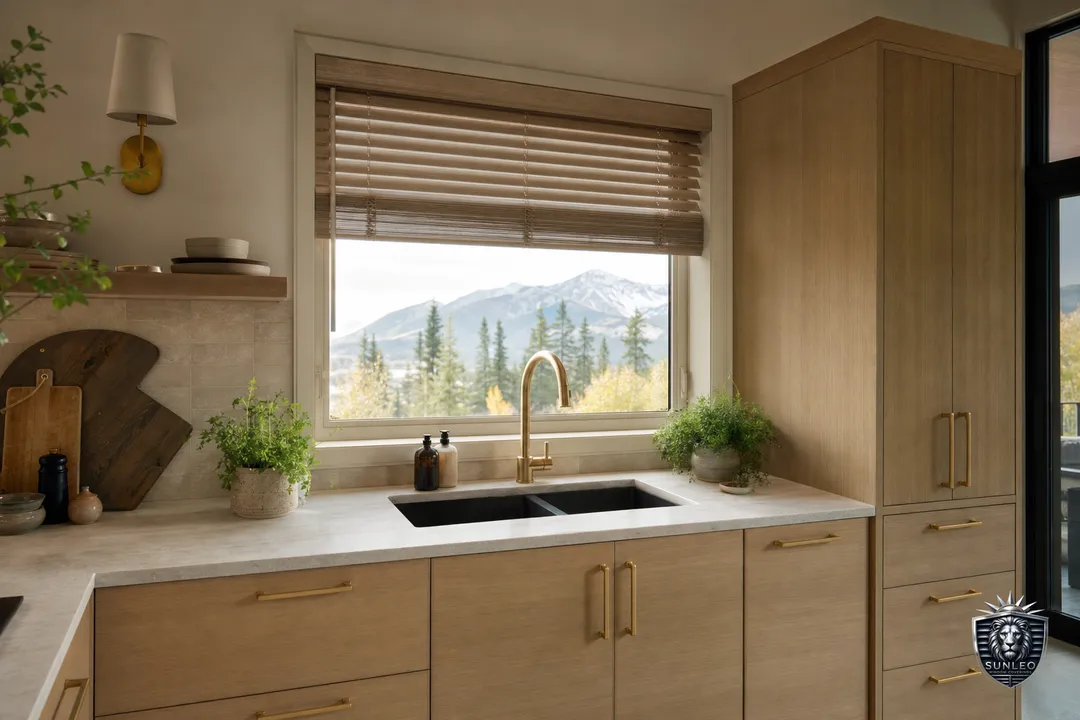
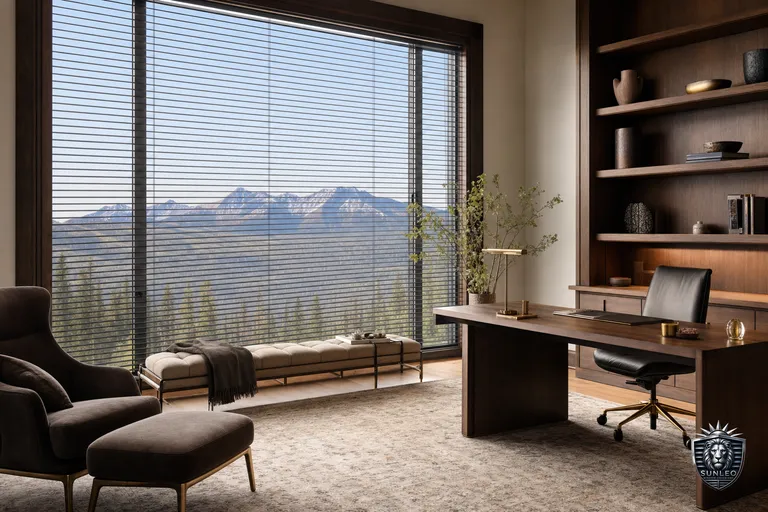
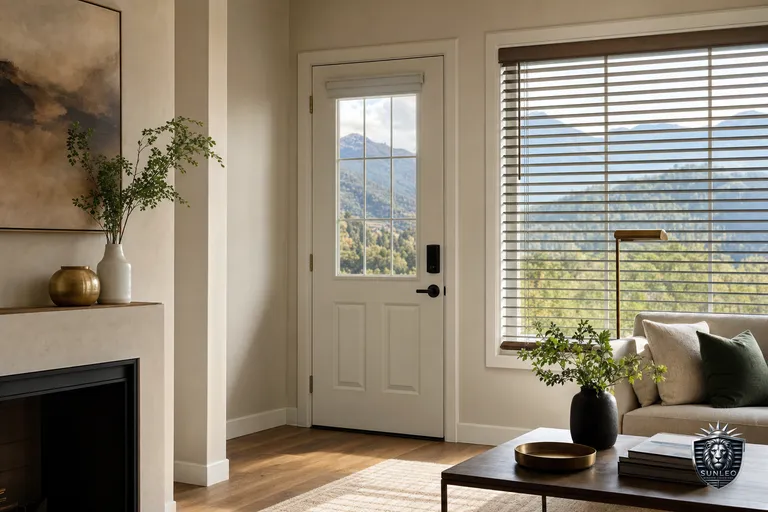
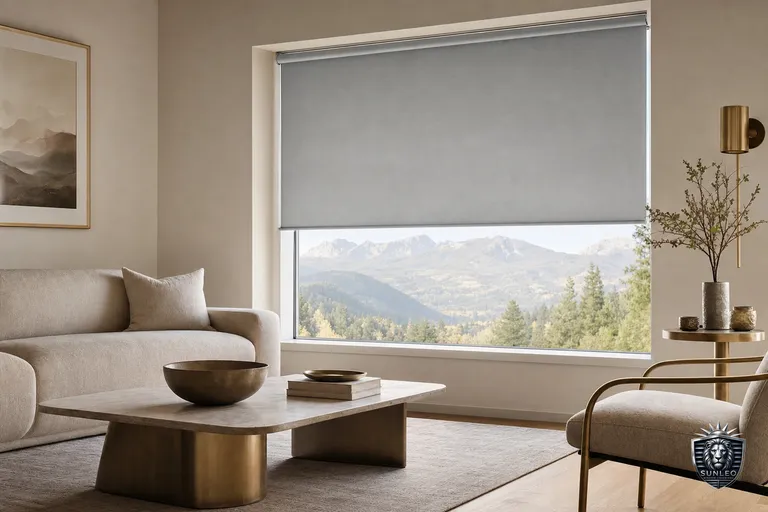
The kitchen is the toughest test any window covering faces. Grease drifts off the stove, steam rises from pots and the dishwasher, and the window over the sink gets splashed and touched with wet hands all day. Whatever you hang here has to wipe clean and survive moisture without warping. Calgary adds its own demands: fierce high-altitude UV that fades soft fabrics, blinding west-facing glare on summer afternoons, and low, short-lived winter sun you want to let in over a workspace. Chinook swings keep the glass cold and prone to condensation too. That's why hard, wipeable materials like faux-wood and aluminum tend to win in this room. Sunleo is a mobile, in-home service with no showroom: a consultant brings real fabric and slat samples to your kitchen, measures every window against your backsplash and cabinets in your own light, and sends a clear written quote within 48 hours. The right blinds for kitchen windows depend on exactly where each one sits relative to your sink and range.
Why the kitchen is the hardest room for blinds
The kitchen punishes window coverings in ways no other room does. Cooking throws a fine mist of grease and oil into the air that settles on every surface, including your slats and fabric. Boiling pots and the dishwasher vent send up steam and humidity. Splatter reaches the window above the sink, and that window gets touched constantly with wet or food-covered hands. Add Calgary's intense high-altitude UV pouring through a south or west window, and a soft fabric shade can look tired within a couple of years.
The honest takeaway: choose for cleanability first, looks second. Hard, wipeable surfaces win here. Aluminum and faux-wood (a moisture-proof PVC version of a wood-look Venetian) shrug off splatter, wipe down with a damp cloth, and never warp or swell the way real wood does over a sink. Roller blinds in a vinyl-coated or PVC fabric also clean with a quick wipe.
What to avoid directly over a working stove or sink: natural woven weaves, real-wood Venetians, untreated linen Romans, and anything that traps grease in folds or honeycomb cells. They look beautiful in a dining nook but become a cleaning chore right at the cooking zone.
A practical compromise many Calgary kitchens use: put a tougher wipe-clean blind on the sink and stove windows, and reserve a softer, warmer shade for the breakfast nook or a window well away from heat. During your free in-home visit, a Sunleo consultant looks at exactly where each window sits relative to your range and sink before recommending a single product.
Reaching over the sink and counter: mounting and controls
The window above the kitchen sink is the one everyone forgets to think about until they're leaning across a wet basin to tug a cord. If you have to stretch over a counter or faucet to operate a blind, a standard chain or cord quickly becomes annoying, and a dangling cord over a sink is also a snag and safety concern.
Three solutions actually work here. First, a spring or cordless lift on a roller or faux-wood blind so a gentle push moves it without any reach for a chain. Second, motorization, which is the genuine star feature in a kitchen: a remote, wall switch, or voice command means you never lean over the sink at all. Rechargeable battery motors avoid wiring and recharge a few times a year. Third, for tilt-only privacy on a Venetian, a wand tilt sits within easy reach.
The honest trade-off: motorized blinds cost more up front and battery units need an occasional recharge, but on an awkward over-sink or behind-the-faucet window the convenience pays for itself daily. Cordless lift is the budget-friendly middle ground and is the safest choice if young kids are around.
Mounting matters too. An inside mount sits cleanly in the frame and keeps the blind out of splatter range, but it needs adequate depth. An outside mount covers a shallow frame and blocks more light. For tile or stone backsplashes that run up to the window, we plan the brackets during measurement so nothing interferes with your backsplash. This is exactly the kind of detail that's easy to get wrong from a website photo and easy to get right in person.
Light, glare and Calgary's climate at the kitchen window
Calgary kitchens deal with two opposite problems across the year. In summer, a west-facing window throws blinding late-afternoon glare straight onto the sink and counter right when you're making dinner, and the high-altitude sun is genuinely fierce here. In winter, the sun sits low and the days are short, so you want to claw back every bit of daylight over a workspace.
The right blind lets you tune between those extremes rather than living at one setting. A faux-wood or aluminum Venetian is excellent for this: tilt the slats to bounce harsh light up off the ceiling while still keeping the view and brightness, or close them flat to kill glare entirely. A roller blind is more all-or-nothing, though a light-filtering fabric softens glare while keeping the room bright and preserving an outline of the view.
The honest trade-off: any blind closed against summer glare also blocks your view and some daylight, so slat-tilt control or a translucent roller fabric is usually more livable in a kitchen than a heavy blackout, which you rarely need over a sink anyway. Zebra blinds cut UV and glare while keeping the view through their sheer bands, but they don't give full nighttime privacy on their own.
UV is the quiet long-term factor. That same strong Calgary sun fades fabrics and finishes over time. Hard aluminum and PVC faux-wood resist fading far better than dyed textiles, another reason they dominate sunny kitchen windows. Chinooks swing temperatures wildly day to day, but they mostly affect comfort and condensation rather than the blind itself.
Privacy, steam and condensation realities
Kitchen privacy needs are usually lighter than a bedroom's, but they're real, especially for a ground-floor or side window facing a neighbour or a back lane. The good news is most kitchen activity happens during the day, so a light-filtering blind that's down but not fully shut often gives enough screening while keeping the room bright. For evening privacy at the sink, a roller you can lower fully, or Venetian slats you can close flat, both do the job.
Moisture is the kitchen's signature challenge. Steam from cooking and the dishwasher, plus splash at the sink, means your blind needs to tolerate humidity without warping, swelling, or growing mildew. This is where material choice is non-negotiable: PVC faux-wood and aluminum are effectively moisture-proof and the safest bet near steam. Vinyl-coated roller fabrics handle damp well too. Real wood and natural fibres are the ones that swell, warp, or stain, so we keep those away from the wet zone.
The honest trade-off: aluminum slats can dent if knocked hard and are cooler and more utilitarian in feel; faux-wood is warmer and more premium-looking but a touch heavier and pricier. Both wipe clean, which is what counts here.
Calgary's dry climate actually helps a little. Indoor humidity is generally low, so persistent mildew is less common than in coastal cities. But cold winter glass plus cooking steam still produces condensation on the window itself, so a blind that resists water and dries easily, rather than soft fabric that sits against a damp pane, is the smarter pick for any window that fogs up.
Budget, durability and getting it measured right
Kitchen blinds span a wide price range, and the sensible way to think about it is cost per year of trouble-free use rather than the sticker alone. Aluminum blinds are typically the most affordable hard-surface option and last for years of wiping; PVC faux-wood costs a bit more for that warmer wood look but holds up just as well to moisture and grease. Roller blinds vary with fabric, with light-filtering and vinyl-coated fabrics sitting in the mid range. Motorization and made-to-measure sizing add to any of these.
Rather than quote fake numbers here, Sunleo gives you a clear written quote within 48 hours of your free in-home visit, with the exact fabrics, sizes, and control options you chose in hand. Because we measure on site, the price reflects your real windows, not a guess.
The durability honest-truth: the cheapest blind that traps grease and warps in steam is no bargain if you replace it in two years. In a working kitchen, a slightly tougher wipe-clean material almost always wins on total cost.
Measuring is where kitchens trip people up. Tiled backsplashes, deep or shallow sills, a window butting against a wall or cabinet, an awkward angle over the sink, and crank or casement windows all change what fits. A blind ordered to a DIY measurement that fouls a backsplash or won't clear a faucet is an expensive mistake. Our consultant measures every window, checks clearances, brings real fabric and slat samples to see against your cabinets and counters in your own light, and confirms the install plan before anything is ordered.


