Cost & Pricing
What Determines the Cost of Blinds? The 7 Price Factors
If you have shopped for window coverings, you have probably noticed the same blind can be quoted at wildly different prices. That is not random — every quote is built from a handful of predictable variables. Understanding what actually drives the number lets you compare quotes fairly, spot where you can save, and decide where an upgrade is worth it. Below are the seven factors that determine the cost of blinds, explained as ranges and trade-offs rather than fixed prices, because your real number depends on your exact windows. For an accurate figure, a free in-home measurement is always the fastest way to a precise Calgary quote.
The 7 factors that determine the cost of blinds
Almost every window-covering quote is built from the same seven inputs. Move any one of them up or down and the price moves with it. Here is the short version before we break each one down:
- Window size — the single biggest driver; price scales with square footage
- Product type — the style you choose (roller, zebra, honeycomb, faux wood, etc.)
- Fabric / material — light-filtering vs. blackout, standard vs. designer grades
- Lift system — cordless, corded, chain, or motorized
- Mount type — inside mount vs. outside mount and framing needs
- Add-on options — liners, valances, cassettes, side channels, colour-matched hardware
- Installation — professional measure and install vs. DIY
1. Window size — the biggest single factor
Size is the number-one cost driver because blinds are priced largely by area. A wide living-room or patio window uses far more fabric, a longer headrail and stronger components than a small bathroom window, so it costs more even in the same style. Very wide openings can also require a heavier-duty tube or a two-on-one bracket, which adds cost. This is also why measuring accurately matters — an inch in either direction changes materials and, on motorized units, the motor size. When you gather quotes, compare price per window of the same size, not just the headline number.
2. Product type and 3. fabric grade
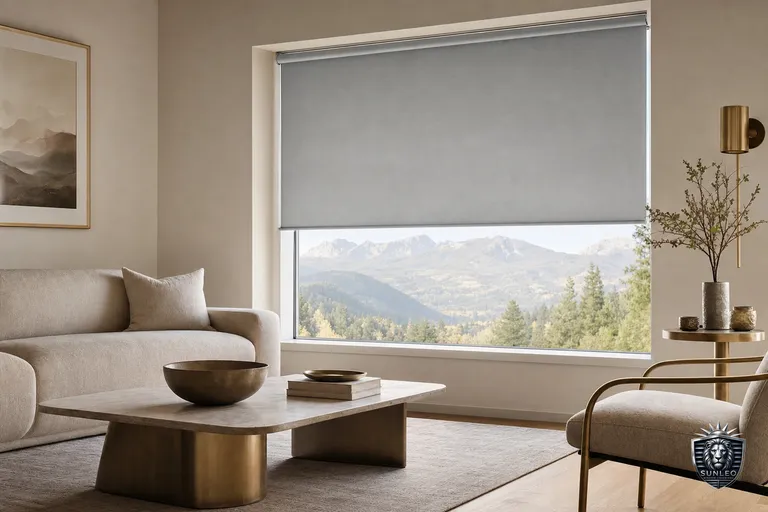
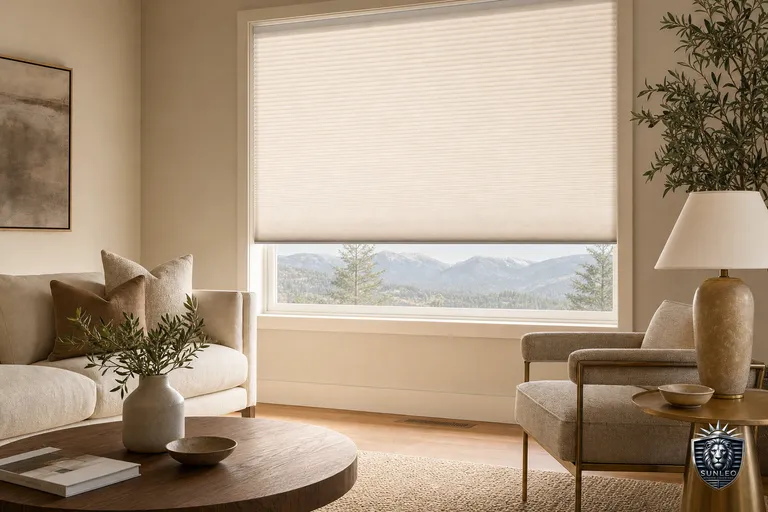
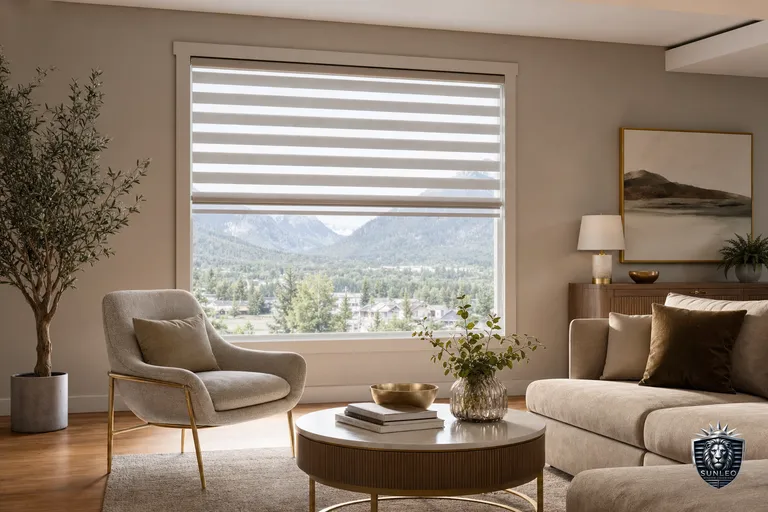
The style you pick sets the baseline. Simpler builds like aluminum or basic roller blinds tend to sit at the lower end, while multi-layer or specialty systems cost more because of what goes into them. As a rough hierarchy from more budget-friendly to more premium: aluminum and basic rollers, then vertical and faux-wood venetians, then zebra/day-night and honeycomb, then sheer shades and roman shades, with skylight, perfect-fit door, printed and fully custom builds at the top because of their engineering. Fabric grade layers on top of that: within any style, blackout and designer textured fabrics cost more than standard light-filtering ones. Honeycomb cellular shades add another variable — single-cell vs. double-cell changes both insulation performance and price, which matters in Calgary winters.
- Budget-friendly: aluminum blinds, basic roller blinds, vertical blinds
- Mid-range: faux-wood venetians, zebra/day-night, honeycomb shades
- Premium: sheer shades, roman shades, skylight, perfect-fit door, printed and custom
4. Lift system and motorization
How the blind raises and lowers has a real impact on price. A standard cordless or chain-driven lift is the most economical. Upgrading to motorization adds the cost of a motor, a rechargeable or hardwired power source, and a remote or hub. Smart-home integration — controlling blinds with Alexa, Google Home, or Apple Home — usually needs a bridge or hub, which is an additional line item but only once per home, not per window. Motorization tends to pay off most on hard-to-reach windows (high, over furniture, or above stairwells) and on large banks of windows you want to move together. For kids' and pets' safety, cordless and motorized options also remove hanging cords entirely.
5. Mount type and 6. add-on options
Inside mount (inside the window recess) gives a clean, built-in look but requires enough depth; outside mount (on the wall or frame) suits shallow or uneven openings and can make a window look larger. Neither is dramatically more expensive on its own, but the mount choice can trigger extras — an outside mount may need a valance to finish the top, while a shallow recess might need a spacer. Add-on options are where budgets quietly grow: light-blocking side channels, cassette or fascia headrails, decorative valances, colour-matched bottom bars, and blackout liners each add cost but also performance and finish. The trick is spending on the upgrades that solve a real problem — for example, side channels on a bedroom blackout blind — and skipping the ones that do not.
7. Professional installation (and why quotes vary)
Installation is the last factor. A professional measure-and-install protects your investment: correct measurements avoid costly remakes, and clean mounting means blinds sit level and operate smoothly for years. It carries a labour cost that DIY does not, but for custom made-to-measure blinds it is usually the safer choice because the fabrication is built to your exact opening. This is also the main reason two quotes for 'the same blinds' differ — one may include in-home measuring, installation and warranty support while the other is supply-only. Always confirm what a quote includes before comparing. At Sunleo we bring the samples to you, measure every window ourselves, and build your quote from the factors above — no showroom trip, no online cart, no obligation.