Buyer's Guide
Types of Roller Blind Fabrics: A Calgary Buyer's Guide
A roller blind looks simple — one panel of fabric on a tube — but the fabric you choose changes almost everything about how the blind performs. Two rollers that look identical from across the room can behave completely differently: one fills a living room with soft, glare-free light, the other blacks out a bedroom at 6 a.m. in June. Get the fabric right and the blind does exactly what you wanted. Get it wrong and you are squinting at a screen all afternoon or staring at a streetlight all night.
This guide breaks roller blind fabrics into the three families that matter — light-filtering, dim-out and blackout — and explains the real trade-offs between UV protection, the view out, glare control and privacy. We have also flagged what Calgary's intense, high-altitude sunlight does to those choices, because our light is genuinely harsher than most of the country. Every fabric here is custom and made to measure, and the best way to judge any of them is to see the sample against your own window — which is exactly what a free in-home measurement is for.
What are the main types of roller blind fabrics?
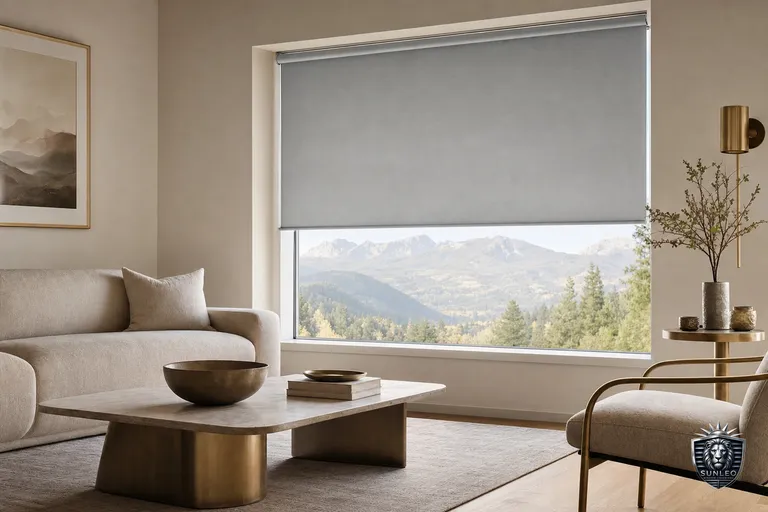
Roller blind fabrics are usually grouped by how much light they let through. From most light to least, there are three families, and almost every roller you will ever choose is a version of one of them.
Think of it as a sliding scale of opacity. At one end, light-filtering fabrics let daylight glow through. At the other end, blackout fabrics are built to stop light dead. Dim-out fabrics sit in between, trading brightness for more privacy and darkness.
The key thing to understand is that there is no single "best" roller fabric — only the best fabric for a particular window and room. A west-facing living room, a baby's nursery and a street-level bathroom each want a different family. Many Calgary homes end up mixing two or three fabric types across the house, which is completely normal.
- Light-filtering: softens daylight and glare, glows warm, adds daytime privacy
- Dim-out: darkens a room significantly without true blackout
- Blackout: blocks nearly all light for bedrooms, nurseries and media rooms
- Want to keep the view? Zebra blinds and sheer shades are the roller-style options for that
What if you want to keep the view while cutting glare?
A lowered roller fabric always hides the view to some degree, so if seeing out matters, the roller family has two close relatives worth knowing.
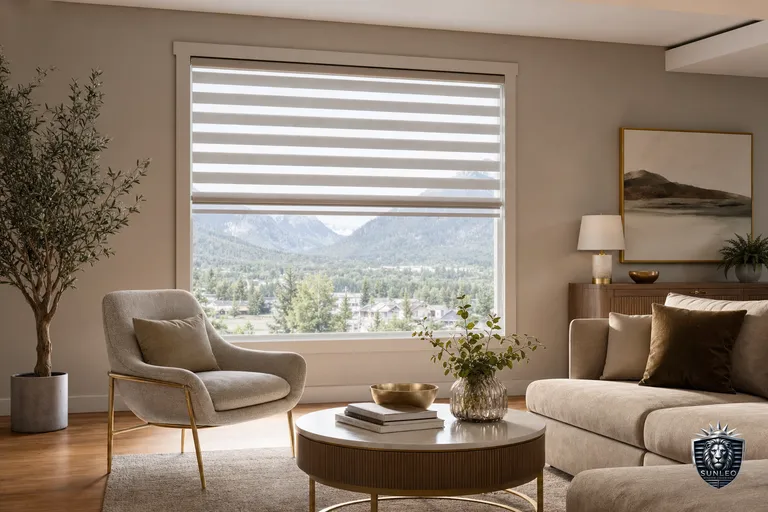
Zebra blinds (day-and-night) alternate sheer and solid bands on a continuous loop. Line up the sheer bands and you see out through a soft, glare-reducing stripe; shift the bands so the solids overlap and the room turns private. Sheer shades float soft fabric vanes between two sheer layers, so you can tilt the vanes for privacy while daylight and the view come through the sheer.
Neither gives full nighttime privacy in its open setting. After dark, when your interior lights are on and it is black outside, anything sheer lets people see shapes inside — close the zebra bands or the sheer vanes, or use a blackout or dim-out roller on bedrooms and street-facing windows.
- Zebra blinds: align the sheer bands to see out, overlap the solids for privacy
- Sheer shades: tilt the vanes for privacy while keeping a soft view
- Great for: home offices, living rooms, south- and west-facing windows, anywhere you want to keep the view
- At night: close the bands or vanes, or pair with a blackout or dim-out roller
Light-filtering vs dim-out vs blackout: privacy and darkness
The three fabric families are about controlling how much light fills the room and how private it feels.
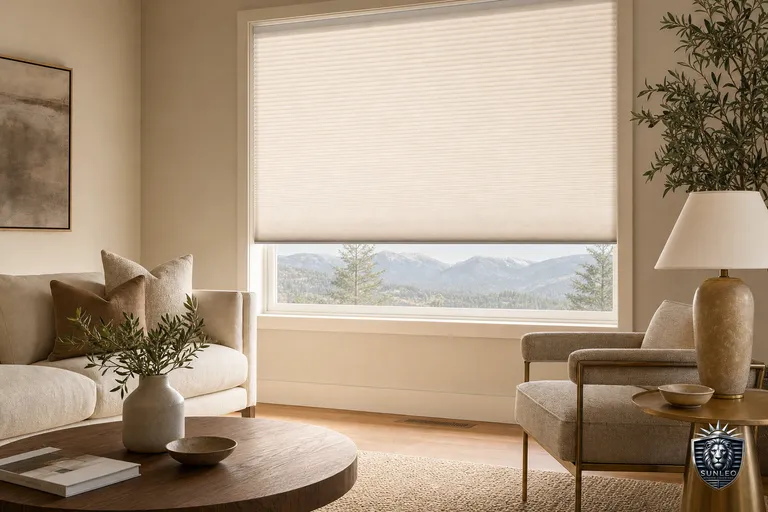
Light-filtering fabrics are translucent rather than see-through. Daylight passes through and the room takes on a soft, even glow, but you cannot make out shapes clearly from either side during the day. They give good daytime privacy and a warm, diffused light that flatters a living room or kitchen. They do not darken a room much, so they are not the answer for a bedroom where you want to sleep in.
Dim-out fabrics (sometimes called room-darkening) are the in-between option. They block most incoming light and cut the brightness dramatically, but a faint amount of light can still creep through the fabric and around the edges. For many bedrooms a quality dim-out is plenty — the room feels dark and restful without being a sealed box.
Blackout fabrics are built with a tight, often coated or multi-layer construction that stops virtually all light from passing through the fabric itself. With the right mount they make a room genuinely dark in the middle of the day. They are the go-to for primary bedrooms, nurseries, shift-workers and media rooms.
One honest caveat about blackout: the fabric blocks the light, but light can still leak around the sides of any roller blind through the small gap between fabric and window frame. If true cave-like darkness matters, an outside mount, a wider blind, or side channels reduce that halo. It is a detail worth raising at your measurement, because the difference between "dark" and "black" is usually about the mount, not the fabric.
What are the trade-offs: UV, view, glare and privacy?
Every roller fabric is a balance of four things, and improving one usually costs you a little of another. Once you can see the trade-offs clearly, choosing gets much easier.
View out: light-filtering blurs it, and dim-out and blackout remove it entirely when closed. If the view is the priority, a zebra blind or sheer shade keeps it.
Glare control: critical if you work from home or watch TV against bright windows. Dim-out and blackout fabrics cut glare well; a light-filtering fabric softens it without darkening the room.
UV protection: this is where fabric choice protects your home, not just your comfort. Calgary's strong sun fades hardwood floors, rugs, artwork and furniture over time. Dim-out and blackout fabrics block the most; lighter, more open fabrics block less. South- and west-facing rooms are where this matters most.
Privacy: separate the daytime and nighttime questions. Light-filtering fabrics give daytime privacy. For nighttime privacy with the lights on, you need a dim-out or blackout fabric — or a layered setup. Treat "privacy" as two different problems and you will choose better.
- Want the view kept? Look at zebra blinds or sheer shades
- Work from home or game? Prioritise glare control with dim-out or a light-filtering fabric
- Protecting floors and furniture from fading? Choose dim-out or blackout on sun-facing windows
- Need to sleep in or darken a nursery? Blackout fabric plus a generous or outside mount
Which roller fabrics suit Calgary's high-altitude sun?
Calgary sits about a kilometre above sea level, and at altitude there is less atmosphere to filter the sun. Combined with our famously high number of clear, sunny days and bright snow-glare in winter, that means our UV and glare loads are genuinely heavier than in many Canadian cities. Roller fabric choice is not just about looks here — it is about protecting your interior and staying comfortable.
A few patterns hold up well in local homes:
For south- and west-facing rooms that take the brunt of afternoon sun, a light-filtering roller softens glare in a living room, while a blackout roller tames a west bedroom; where you want to keep the mountain or yard view, a zebra blind does the same job with its sheer bands aligned.
For bedrooms and nurseries, blackout fabric is the obvious pick — useful in June when the sun is up before 5:30 a.m., and again in winter for blocking early streetlight and snow glare.
For living rooms and kitchens where you want warmth and daytime privacy without going dark, a light-filtering fabric gives that soft, glowing light most of the year.
Because our UV is so strong, fade resistance is worth prioritising on any sun-facing window regardless of family — a slightly better fabric pays for itself in floors and furniture that do not bleach out. It is also one more reason that lighter colours, which show fading less and reflect heat, are popular on Calgary's hottest exposures.
How do you choose the right roller blind fabric?
You can narrow the decision in a few minutes by asking what each window actually needs to do, then matching it to a fabric family.
Start with the room's job. Sleeping or watching screens points to blackout or dim-out. Keeping a view while cutting glare points to a zebra blind or sheer shade. A soft, private everyday glow points to light-filtering. Note the window's direction too — south and west exposures push you toward more UV and glare control.
The one step that is genuinely hard to do from a website is judging colour and opacity. Fabrics read completely differently in your own light than on a screen or a tiny swatch in a store. A blackout's exact darkness, the way a light-filtering colour glows at noon — all of it depends on your specific window, glass and wall colour.
That is exactly why Sunleo brings the samples to you. Here is how it works:
1. Book a free in-home consultation — there is no showroom to drive to. 2. A specialist brings real roller fabric samples and holds them against your actual windows and daylight, so you can compare light-filtering glow, dim-out and blackout darkness in the room they are for. 3. Every window is measured precisely for a gap-free, made-to-measure fit. 4. You receive a clear written quote within 48 hours — no pressure and no online checkout.
Sunleo serves Calgary and surrounding communities including Airdrie, Okotoks, Cochrane, Chestermere and Strathmore. If you are weighing roller fabrics for even one tricky window, a free in-home measurement is the simplest way to see the options side by side and choose with confidence.