Buyer's Guide
Blinds for Specialty-Shaped Windows: Arched, Bay, Corner, Garden, Transom & Skylight
Not every window is a simple rectangle. Calgary homes — from Mount Royal character houses to new Nolan Hill builds — are full of arches, bays, corners, garden boxes, transoms, and skylights that standard blinds simply won't fit. Each shape has its own physics: some need a track that curves, some need two frames to meet at an angle, some need a lift system that works sideways or upside-down. Guessing wrong means a blind that binds, gaps, or can't be reached at all. Below is a quick guide to each specialty shape Sunleo regularly measures and fits across Calgary, Airdrie, Okotoks, Cochrane, Chestermere, and Strathmore, with links to a full how-to page for each. If your window doesn't look like a standard rectangle, start here.
Arched & Eyebrow Windows
Arched, circle-top, and full-circle "eyebrow" windows are usually left bare because a straight roller or standard headrail can't follow a curve. The fix depends on how much of the arch is fixed glass versus operable: a fixed arch can take a custom-shaped fabric panel or a static cellular insert cut to the curve, while an arch sitting above a operable rectangle usually gets a fixed arch treatment paired with a working blind below it. Full circles and true eyebrows are rare enough that they're treated as one-off template cuts. See our dedicated Arched Window Blinds guide for full mounting options.
- Fixed arch above a window: static shaped panel, arch stays uncovered by moving parts
- Full circle or eyebrow: custom template cut, usually fixed rather than operable
- Best paired products: Roman shades or honeycomb inserts for a clean fabric line
Bay Windows
A bay window is three (or more) flat window units angled together, which means three separate blinds meeting at two mitred corners. The challenge isn't the shape of any single pane — it's making the corners line up so there's no light gap and the headrails don't collide when raised. Corded and cordless roller or cellular shades both work, but the angle of each corner needs to be measured on-site, not estimated from a floor plan. Our Bay Window Blinds guide covers inside-mount vs outside-mount choices and how we handle the corner returns.
- 3+ individual window units, each measured and mounted separately
- Corner returns need on-site angle measurement, not a general estimate
- Cordless lift is popular here since bay seats often sit right under the windows
Corner Windows
Corner windows — two window units that meet directly at a wall corner with little or no post between them — create the same headrail-collision problem as bays, but at a tighter angle. Brackets have to be set close enough that the two blinds clear each other when lowered, without leaving a light gap at the seam. This is one of the shapes we see most in newer Calgary builds with open, glass-forward architecture. Full mounting detail is in our Corner Window Blinds guide.
- Tight-angle bracket placement to prevent headrail collision
- Common in newer Calgary and Airdrie homes with open corner glazing
Garden Windows
A garden window is a boxed-out window that projects from the wall with its own small side panels, top, and sometimes a glass shelf — often above a kitchen sink. The side panels are usually narrow and angled, and depth can make a standard outside-mount bracket useless. We typically fit garden windows with narrow inside-mount cellular or roller shades cut to each panel's exact width, keeping hardware low-profile so it doesn't crowd the shelf. See the Garden Window Blinds guide for panel-by-panel measuring steps.
- Narrow side panels usually need inside-mount, low-profile hardware
- Sink or shelf underneath means clearance matters as much as width
Transom Windows
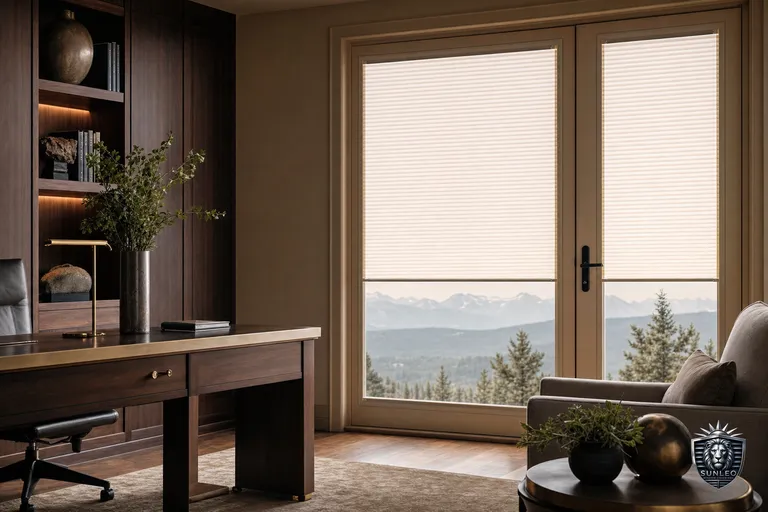
Transoms — the narrow windows above a door or above a taller window — are easy to forget until morning glare hits or a streetlight shines straight through at night. Because they're small, high, and often hard to reach, transoms are one of the best candidates for a no-drill Perfect Fit style frame or a motorized lift, rather than a pull cord nobody wants to stretch for. Our Transom Window Blinds guide walks through mount options for both operable and fixed transoms.
- High and hard to reach: a strong case for motorized or no-drill mounting
- Fixed transoms can take a static shaped insert instead of a working blind
Skylight & Sloped-Glass Windows
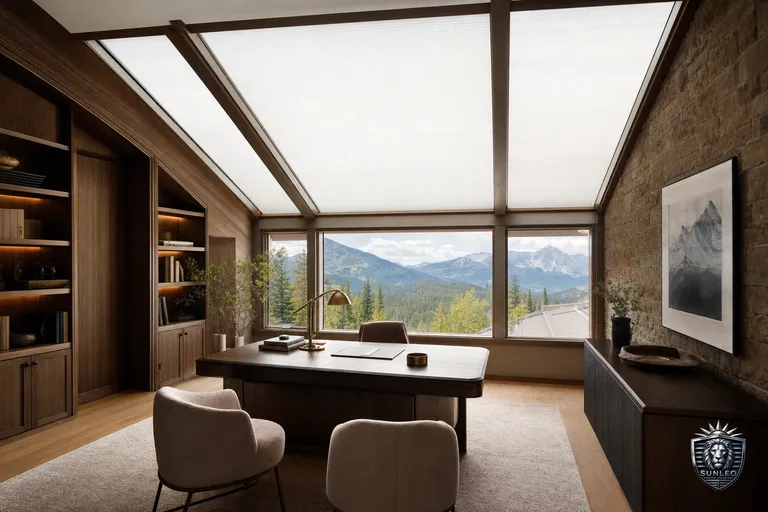
Skylights and sloped-glass windows face gravity, not just measurement — the shade has to stay in position on an incline without sliding down under its own weight. That's why skylight coverings use a side-channel, track-guided system rather than a standard headrail. Because most skylights sit well out of arm's reach, motorized operation is the practical choice for day-to-day use, and it pairs with generic smart-home platforms like Alexa, Google Home, or Apple Home for scheduled opening and closing. See our Skylight Blinds product page for the full track-guided system and motorization options.
- Side-channel, track-guided system holds the shade against an incline
- Motorized operation is the practical standard given the height
- Works with Alexa, Google Home, and Apple Home for scheduling