Buyer's Guide
Openness Factor on Blinds Explained: View, Glare and Privacy
"Openness factor" is one of the most misunderstood terms you'll see when shopping for blinds. It quietly decides how much of your view you keep, how much glare you cut, and whether people can see inside after dark. This guide explains the idea in plain terms, shows how it maps onto the fabrics you can actually choose, and how to match the right level of openness to each window's exposure, especially in Calgary's bright, high-altitude light.
What does openness factor mean on a blind?
Openness factor (sometimes called "open weave") describes how much of a fabric is open space, the tiny gaps between the yarns, versus solid material. Blackout fabrics are effectively fully closed; sheer fabrics are the most open.
The key trade-off is simple: the more open the fabric, the more you can see out, but the more light and glare pass through. The more closed the fabric, the better it blocks sun and glare, and the more privacy you keep, at the cost of the view.
- More open = clearer outward view, more daylight, less glare and privacy control
- More closed = more glare control and privacy, less view
- Blackout fabrics are effectively closed; sheer is the most open
- Fabric colour matters too: darker fabrics give a sharper view-through, lighter ones reflect more heat
How openness maps onto the fabrics you can choose
Rather than comparing weave percentages, it's easier to think in terms of the fabrics Sunleo actually makes, from most open to most closed.
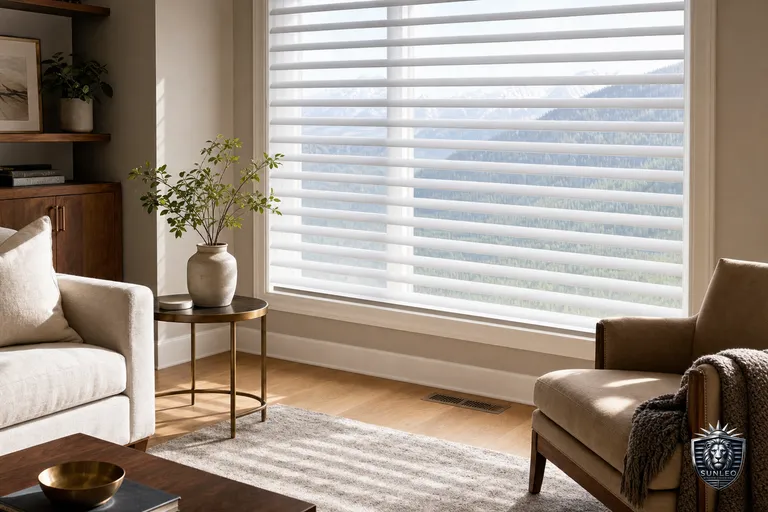
- Sheer shades: soft fabric vanes between two sheer layers. The sheer keeps a hazy view; tilt the vanes for privacy.
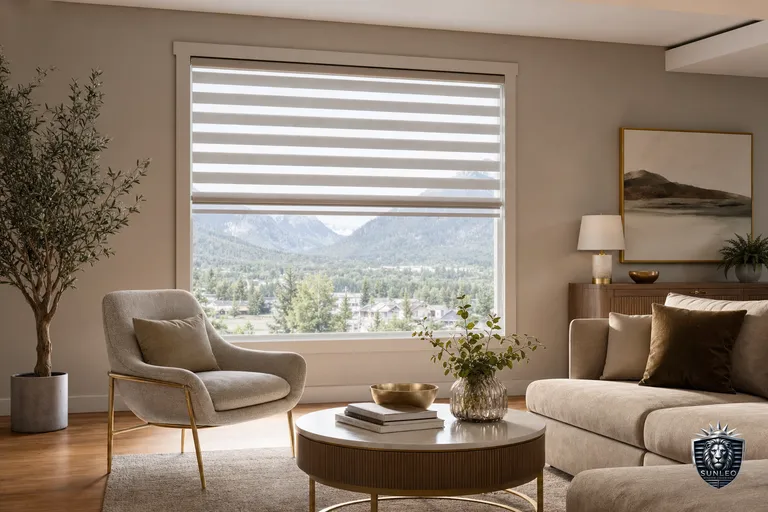
- Zebra blinds: alternating sheer and solid bands. Align the sheer bands to see out; overlap the solids for privacy.
- Light-filtering rollers and honeycomb: translucent, so daylight glows through and glare softens, but the view is blurred.
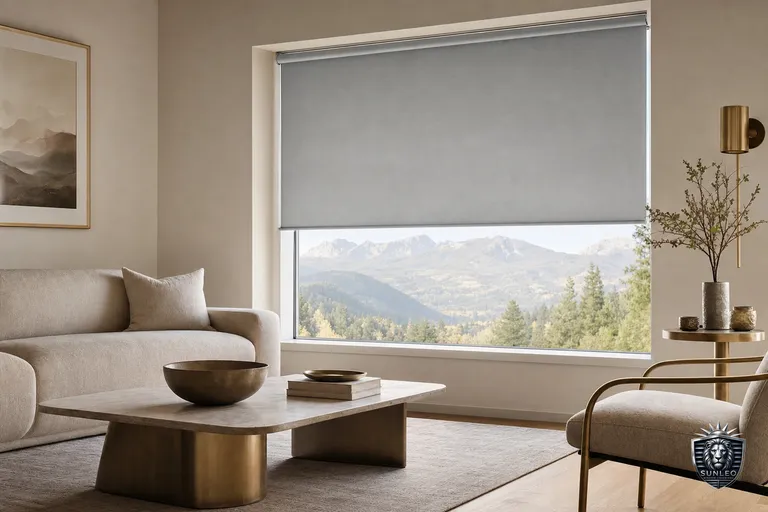
- Dim-out and blackout: closed fabrics for darkness, sleep and screens. No view while lowered.
- Nighttime note: with interior lights on, any fabric that lets light through can show silhouettes from outside. Close the zebra bands or sheer vanes, or use a blackout layer where night privacy matters.
How to choose by window exposure
The right level of openness depends on which direction a window faces and what the room is used for. In Calgary, intense high-altitude sun and long summer daylight make glare and heat control especially valuable on sun-facing windows, while north windows can afford a more open fabric.
- South & west windows (hottest, most glare): honeycomb for heat, blackout rollers in bedrooms, or a zebra blind where you want to keep the view
- East windows (bright morning sun): light-filtering or zebra to soften early glare
- North windows (soft, indirect light): sheer or light-filtering to maximize daylight
- Home office / TV room: zebra or dim-out to protect screens from glare
- Rooms with a prized view: zebra blinds or sheer shades
- Bedrooms / bathrooms: openness alone won't give night privacy, choose blackout or dim-out
Openness vs UV and privacy: don't confuse them
Openness and UV protection are related but not identical. A more closed fabric generally blocks more sun, but the exact performance depends on the fabric and colour, so ask about it when you see samples. Likewise, openness affects daytime privacy and view, but never guarantees nighttime privacy on its own.
If your main goal is fading protection on a sun-facing window, a dim-out or blackout fabric or a honeycomb shade does more than an open one. If your goal is total darkness or full privacy, openness is the wrong lever: you want a blackout roller, a zebra blind with the solid bands closed, or a layered solution instead.