Buyer's Guide
Do Blinds Give Privacy at Night? What Really Happens After Dark
A blind that feels perfectly private at 2pm can leave you on display at 9pm. It is one of the most misunderstood things about window coverings: privacy is not a fixed property of a blind — it flips with the light. During the day the sun outside is brighter than your rooms, so even semi-transparent fabrics keep the outside world from seeing in. At night that balance reverses. Your lamps and screens become the brightest thing around, and any fabric that lets light through will also let eyes through, projecting your movements as silhouettes onto the street. This guide explains exactly what happens to blinds after dark, which fabrics and setups deliver genuine night privacy, and which ones quietly fail once the sun goes down. It matters especially in Calgary, where winter darkness arrives before 5pm — meaning \"night privacy\" is really most-of-your-evening privacy for half the year.
Do blinds actually give privacy at night?
It depends entirely on the fabric and how the blind closes. The honest answer is that a lot of blinds people assume are private are not private at night — because privacy is governed by the difference in brightness between inside and outside, not by whether a blind is simply "down."
During the day, sunlight outside overpowers your interior lighting. That brightness gradient is what stops a passerby from seeing through a light-filtering roller or a sheer shade: the fabric glows softly but hides what is behind it. Once it is dark outside and your lights are on, the gradient flips. Now the brightest light is behind the fabric — inside your home — and it pushes straight through any material that is not fully opaque. The result is the classic lit-window silhouette: shapes, movement, and rough outlines clearly visible from the sidewalk, even though the blind is closed.
So the same blind can be completely private at noon and effectively see-through at night. If after-dark privacy matters in a room — bedrooms, bathrooms, ground-floor living rooms facing a street or a close neighbour — you cannot judge a fabric by how it looks in daylight. You have to ask what it does when the light is behind you.
Why do blinds become see-through after dark?
It comes down to one simple rule of light: you can see from the darker side toward the brighter side. Fabric that is translucent — meaning light passes through it — will always let the view travel in whichever direction the light is travelling.
- Daytime: bright outside, darker inside → the view runs outside-to-in is blocked, so you have privacy, but you can still see out. - Nighttime with lights on: bright inside, dark outside → the view runs inside-to-out, so people outside see your silhouette while you can barely see them.
This is why turning on a lamp behind a sheer or light-filtering shade is like switching on a projector. The fabric that looked reassuringly opaque all afternoon suddenly reveals outlines of people, furniture and movement. The more light you have on inside, and the thinner or more open the weave, the more clearly you are visible.
Two practical takeaways follow. First, only genuinely opaque materials — blackout coatings, tightly lined fabrics, or solid closed slats — stop the projector effect completely. Second, reducing interior light (dimmer lamps, lights off in the room you want private) improves night privacy with any blind, but it is a workaround, not a fix.
Which blinds give true privacy at night?
For reliable after-dark privacy, you want materials that block light rather than filter it, or setups that layer an opaque element. These are the options that hold up once your lights are on:
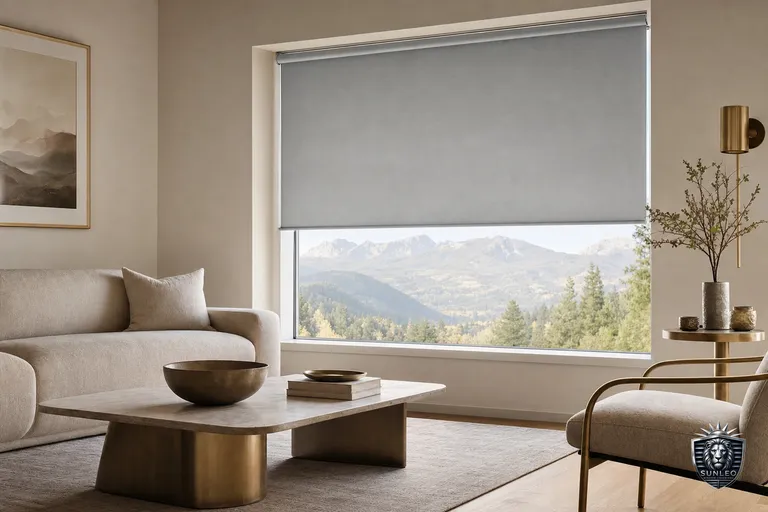
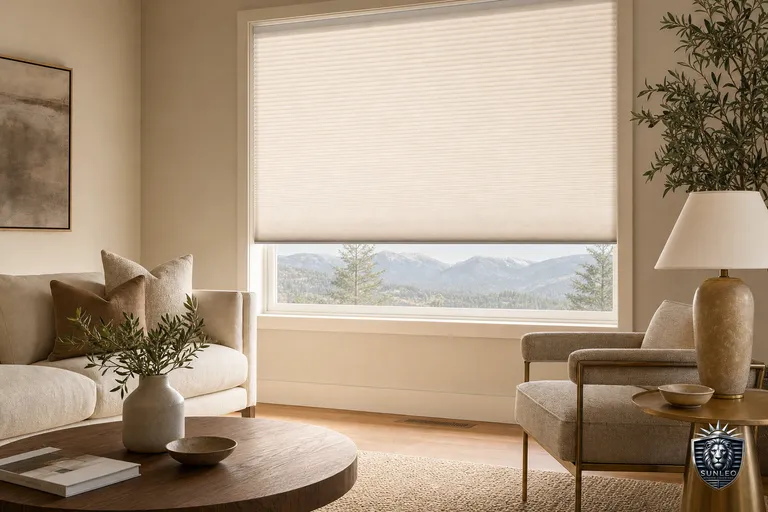
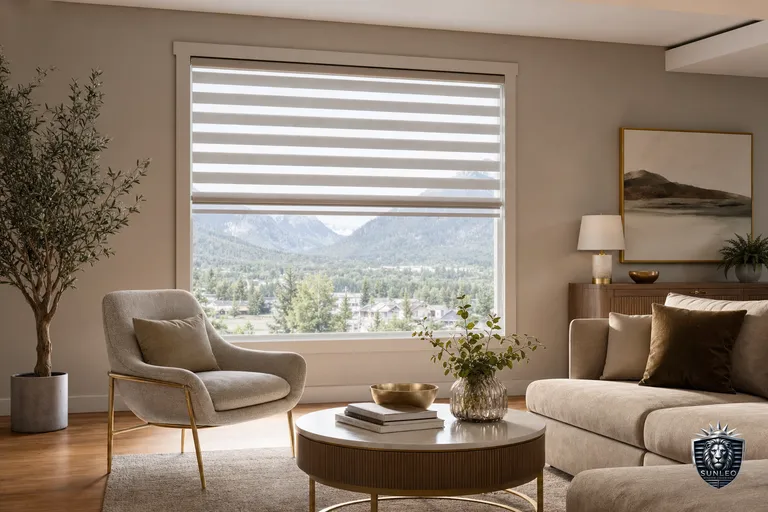
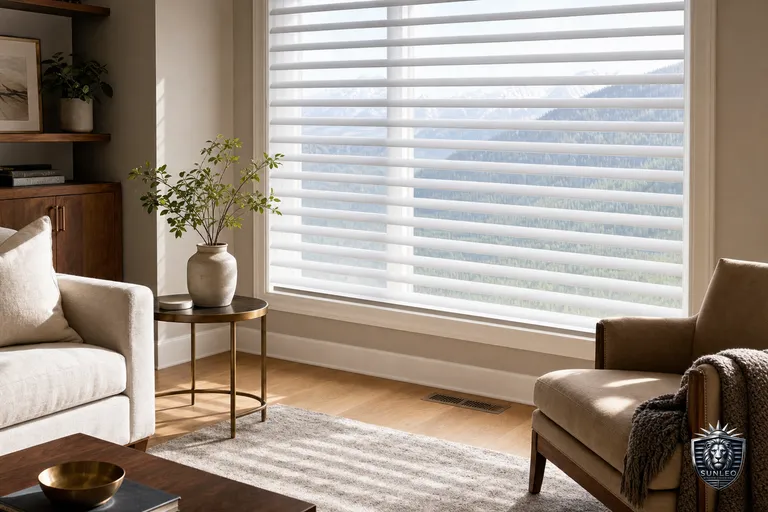
- Blackout roller blinds: a true blackout or room-darkening fabric is opaque, so no silhouette shows through the body of the fabric. This is the most straightforward night-privacy choice for bedrooms and street-facing rooms. - Lined or room-darkening Roman shades: the fabric plus an opaque backing lining stops light passing through, giving both privacy and a soft, decorative look. - Blackout honeycomb (cellular) shades: available with a room-darkening or blackout cell, they add insulation — valuable in Calgary's cold — while blocking the after-dark view. - Closed venetian, faux-wood, aluminum or vertical slats: when the slats are tilted fully shut, the solid surfaces block the direct sightline. Privacy here is very good, with one caveat covered in the next section. - Day-and-night (zebra) blinds set to their solid bands: when the opaque stripes are aligned to overlap the sheer ones, a zebra blind blocks far more of the view than in its see-through position — though it is a room-darkening effect, not full blackout.
The common thread is opacity. If a fabric is described as blackout or room-darkening, it is built to stop light — and therefore stops the night-time view. If it is described as light-filtering or sheer, assume it will show silhouettes after dark.
Which blinds don't give night privacy on their own?
Several popular window coverings are excellent for daytime glare and softness but do little for you at night. Knowing which ones is the whole point of this guide.
- Sheer and light-filtering shades: sheer shades and translucent fabrics are designed to let light through, so by definition they let the view through too once you are backlit. Beautiful by day, effectively transparent to silhouettes at night. - Standard light-filtering rollers and honeycombs: the non-blackout versions glow and reveal shapes after dark. Perfect for a bright kitchen; not enough for a bedroom. - Zebra blinds in the open position: with the sheer bands aligned, you can see out — and at night, others can see in.
There is also a subtler issue with slatted blinds and some blackout rollers: light and view gaps. Even closed venetian or vertical slats leave hairline sightlines between slats and small light gaps at the tilt-cord holes and edges. Blackout roller and Roman shades block the fabric itself, but light can still leak — and a determined sightline sneak — around the sides where the fabric meets the window frame. For bedrooms where total darkness and privacy matter, an outside mount or side channels close those gaps. This is exactly the kind of detail that is easy to miss until the blinds are installed and the first dark evening arrives.
How do you keep night privacy without losing daytime light?
The frustration with pure blackout is obvious: block the night-time view and you also block the daytime sun. The best setups solve both by separating the two jobs. Three approaches work especially well:
- Top-down-bottom-up honeycomb shades: these let you lower the shade from the top or raise it from the bottom. In the evening you cover just the lower two-thirds of the window — the part people can see into from the street — while leaving the top open for a sense of sky and light. It is one of the most elegant answers to the night-privacy problem. - Dual / double roller shades: two blinds on one bracket, typically a light-filtering fabric paired with a blackout fabric. Run the light-filtering layer by day for soft daylight; pull down the blackout layer at night for complete privacy. One window, both behaviours. - Day-and-night (zebra) blinds: the built-in version of the same idea — align the sheer bands for daytime view, shift to the solid bands for evening privacy, all in a single blind.
For rooms where you never need a view — powder rooms, ensuites, street-level bathrooms — a dim-out roller is worth mentioning too: left down it holds the sightline around the clock, and it is the simplest thing to fit where a view was never the point. The right choice depends on the room, the direction it faces, and how close your neighbours are — which is best judged with samples held up against your own windows, in your own evening light.
How do you get night-private blinds in Calgary?
Because night privacy hinges on fabric opacity and how a blind closes against your specific window, the surest way to get it right is to see the fabrics in your own home — held against the actual window, ideally imagining it after dark. That is how Sunleo works, and there is no showroom to visit because the consultation comes to you.
Here is the process:
1. Book a free in-home consultation. A Sunleo specialist visits at a time that suits you, anywhere in Calgary and surrounding communities. 2. See real blackout, room-darkening and sheer samples in your space, so you can judge exactly what each fabric hides — and reveals — in your own light. 3. Get precise measurements, including outside mounts or side channels where you need to close the light and privacy gaps around bedroom windows. 4. Receive a written quote within 48 hours, with no pressure and no obligation.
Sunleo serves Calgary plus Airdrie, Okotoks, Cochrane, Chestermere and Strathmore. If night privacy is the reason you are looking at blinds — a street-facing living room, a bedroom that never feels quite private after dark — booking a free in-home measurement is the simplest way to see which fabric actually solves it for your windows.
- Blackout/room-darkening fabric = private at night; light-filtering/sheer = not
- Silhouettes appear because interior light is brighter than outside after dark
- Dual shades, zebra blinds and top-down-bottom-up keep day view + night privacy
- Watch for light and sightline gaps at slat edges and around fabric edges
- Reducing interior lighting helps any blind, but only opacity truly fixes it