Comparison
Blackout vs Room-Darkening Blinds: What Actually Goes Dark?
"Blackout" and "room-darkening" get used as if they mean the same thing, and the labels on cheap ready-made blinds rarely make it clearer. They are not the same — but the difference between them is also smaller and less important than most homeowners think. The part that actually decides whether your bedroom goes properly dark is something the fabric name never tells you: the light that leaks around the sides, top and bottom of the blind. You can buy the most expensive blackout fabric on the market and still wake up to glowing edges at sunrise. This guide explains the real, honest difference between blackout, room-darkening and light-filtering fabrics, why the edges matter more than the middle, and which combination of fabric and mount actually delivers a dark bedroom, nursery or media room — especially under Calgary's bright, low-angle prairie sun. The figures and recommendations here are general guidance; we confirm the right setup for your specific windows with a free in-home measurement.
Blackout vs room-darkening vs light-filtering: the real difference
There are really three opacity levels, and they sit on a spectrum.
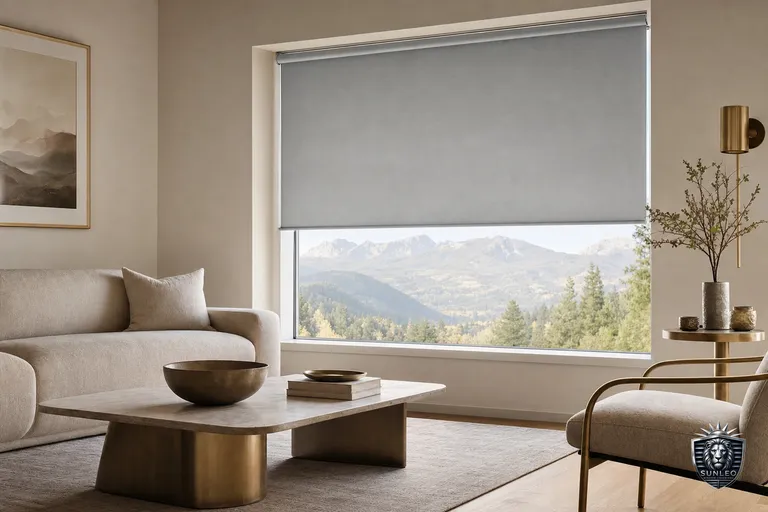
Blackout fabric is built to stop light passing through the material itself. It's either tightly woven, foam-coated, or layered with a backing so that when you hold it up to a bright window, you see no light through the cloth — just the silhouette of the fabric. It's the darkest option you can put on a window.
Room-darkening (sometimes labelled "dim-out") sits one step down. It blocks most light but not quite all of it — hold it to the sun and you'll see a faint, even glow through the weave rather than true black. In a bedroom at night it feels dark; at noon in summer it takes a room to a comfortable dusk rather than pitch black.
Light-filtering (and the sheerest "privacy" fabrics) is the opposite end. It softens and diffuses daylight, cuts glare and gives daytime privacy, but it is meant to let light in. It will never darken a room and isn't trying to.
The honest takeaway: blackout and room-darkening are close cousins, and for many rooms the gap between them is smaller than the marketing suggests. Light-filtering is the one that's genuinely different — don't expect any darkness from it.
- Blackout: blocks essentially all light through the fabric — appears solid against the sun
- Room-darkening / dim-out: blocks most light, leaves a faint even glow
- Light-filtering / sheer: diffuses daylight for glare control and daytime privacy, never darkens
- The jump from light-filtering to room-darkening is big; room-darkening to blackout is small
The catch nobody mentions: light at the edges
Here's the part that matters more than the fabric label, and the part most blinds are sold without explaining. The opacity rating only describes light coming through the cloth. It says nothing about the light that travels around the blind — down the sides, over the top of the headrail, and under the bottom rail.
On a standard inside-mounted blind (one fitted inside the window frame), there's always a small gap on each side so the blind can raise and lower without scraping. That gap is usually only a few millimetres, but it's a direct channel for daylight. With a true blackout fabric, those gaps don't just let in light — they create bright, glowing lines exactly where the dark fabric makes the contrast most obvious.
Calgary makes this worse than almost anywhere. We're at high altitude with intense, clear-sky light, and in winter the sun tracks low across the sky, so it streams in nearly horizontally — straight through side gaps at pillow and eye height. A west-facing bedroom catching long June evenings, or a nursery you're trying to use for daytime naps, will show those edges no matter how good the fabric is.
So the real question isn't only "blackout or room-darkening?" It's "how do I close the edges?" That's a mounting and system decision, not a fabric one.
- Opacity ratings only describe light through the fabric, not around it
- Inside-mounted blinds leave small side gaps that glow against dark fabric
- Calgary's low winter sun drives straight through edge gaps at eye level
- Closing the edges is about mount and system, not the fabric grade
Which actually darkens a bedroom, nursery or media room
For rooms where darkness genuinely matters — a primary bedroom, a shift-worker's room, a baby's nursery, or a media room where you want the TV to read properly midday — the fabric is only half the answer. You need to handle the edges too.
The most reliable approach is an outside mount: fitting the blind on the wall above the opening so the fabric overlaps the frame on every side. With no edge for light to slip past, even a good room-darkening fabric can outperform a blackout fabric that's inside-mounted with glowing gaps. For the darkest possible result, pair blackout fabric with an outside mount or a side-channel system.
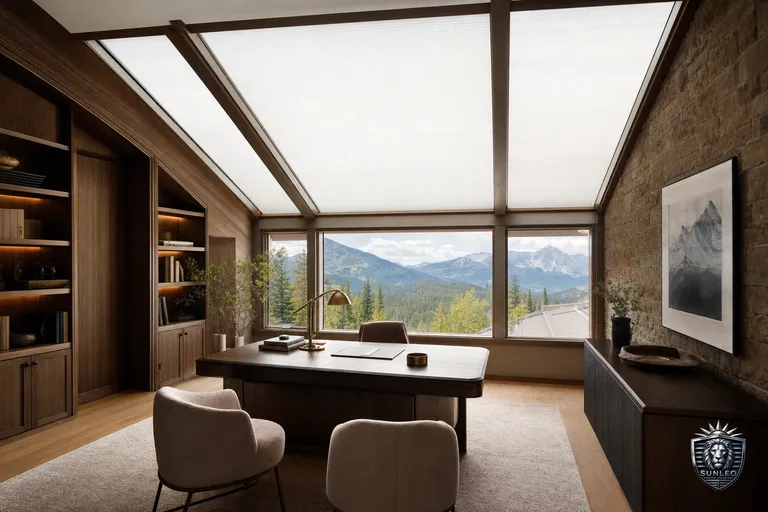
Side channels (also called blockout channels) are the other strong option, especially when you love the clean inside-mount look. The blind runs inside slim tracks fixed to the sides of the reveal, so the fabric edges are captured and light can't escape around them. Skylight blinds use the same track-guided idea overhead, which is essential because an unguided shade on a sloped or ceiling window would just sag and leak.
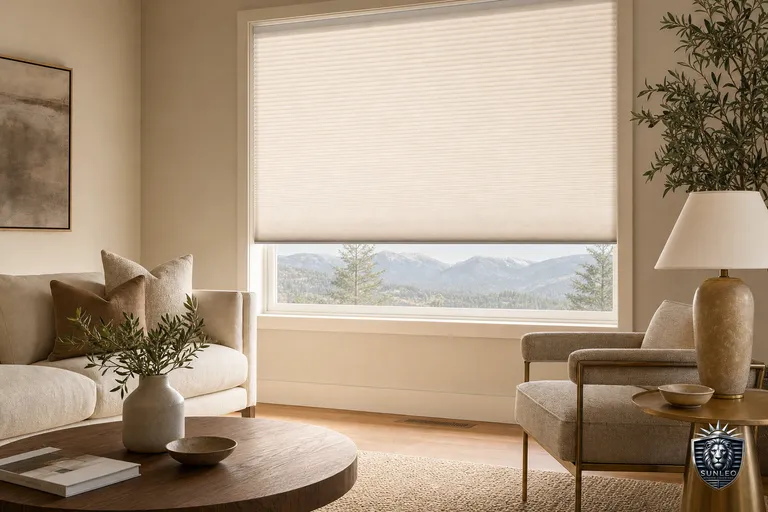
Cellular (honeycomb) shades in a blackout grade are a popular nursery and bedroom choice because the pleated cells trap a little air and the fabric is opaque, but they still need edge management — a snug fit or side channels — to reach true darkness.
For a media room, room-darkening is often enough: you want to kill glare and screen wash-out, not necessarily achieve total black. For sleep, lean blackout plus closed edges.
- Outside mount overlaps the frame and removes edge light — the single biggest factor
- Side channels close the gaps while keeping a tidy inside-mounted look
- Skylight and sloped windows need track-guided systems to darken at all
- Nursery / sleep: blackout fabric + closed edges; media room: room-darkening usually suffices
Fabric and mount: how the choice actually plays out
In practice, you're choosing two things together — the fabric grade and how it's fitted — and they trade off against each other.
If you want the crisp, built-in look of an inside mount and you've chosen blackout fabric, accept that you'll see faint edge lines unless you add side channels. That's a perfectly good choice for a guest room or a room where "quite dark" is fine. If you must have true cave-like darkness — a baby who naps at noon, a night-shift nurse sleeping through a bright Calgary afternoon — plan for an outside mount or channels from the start, and don't rely on fabric alone.
Fabric also affects more than darkness. Blackout and room-darkening fabrics add a little insulation and noise dampening, which is welcome through Calgary winters and on busy streets. Heavier blackout fabrics on very large windows can feel weighty, which is one reason motorization is popular on big bedroom or media-room windows — and it lets you schedule them to close before a west-facing summer sunset.
Colour matters too: a dark-backed fabric reads dramatically different from a pale one in the same opacity, and pale blackout fabrics can still show a subtle halo at the edges. We bring real samples so you can hold them against your own light rather than guess from a screen — the same fabric looks different in a north-facing condo and a south-facing bungalow.
- Inside mount + blackout = clean look but visible edge lines unless channelled
- Outside mount or side channels = the route to true darkness
- Blackout / room-darkening fabrics also add insulation and noise dampening
- Motorization suits large or heavy blackout blinds and scheduled closing
Which should you choose — and what we recommend
Here's the short version. Choose blackout when the room's main job is sleep or total darkness and you're willing to handle the edges with an outside mount or channels — primary bedrooms, nurseries, and rooms for people who sleep during the day. Choose room-darkening when you want a dim, comfortable, glare-free space but don't need pitch black — media rooms, TV areas, bedrooms where a little ambient light at dawn is fine, or spaces where you want some softness rather than a hard cut-off. Choose light-filtering only when darkness isn't the goal and you're after daytime privacy and diffused glare control.
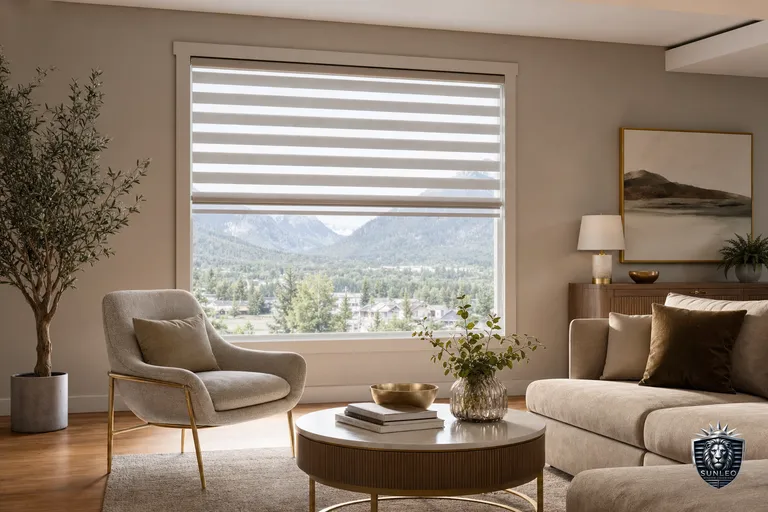
For most Calgary homes we end up recommending a layered or per-room approach: blackout with closed edges in the bedrooms and nursery, room-darkening or a dual zebra/sheer setup in living spaces, and the right track-guided system on any skylight. The home stays consistent in style while each room gets the darkness it actually needs.
This is genuinely easier to get right in person than off a spec sheet. When our consultant visits, we check which way each room faces, where the sun lands through the day, your reveal depth and handle clearance, and whether an inside mount with channels or an outside mount suits each window. We bring fabric samples to hold against your real light, then recommend the fabric grade and mount window by window so it's dark where you want it and bright where you don't. The measurement and advice are free, with no obligation.
- Blackout: sleep and true darkness — pair with outside mount or side channels
- Room-darkening: dim, glare-free comfort without total black — great for media rooms
- Light-filtering: daytime privacy and softened light, not darkness
- We recommend fabric grade and mount per room after seeing your real light, free
| Blackout | Room-Darkening | |
|---|---|---|
| Light through the fabric | Blocks essentially all of it — appears solid | Blocks most; a faint even glow remains |
| Look against the sun | No light visible through the cloth | Soft glow through the weave |
| Best for | Bedrooms, nurseries, day sleepers | Media rooms, TV areas, gentle dimming |
| Edge light (if inside-mounted) | Glowing side lines stand out against dark fabric | Edge lines less obvious but still present |
| To reach true darkness | Add outside mount or side channels | Often enough as-is; channels for more |
| Insulation / noise | Good — heavier, opaque construction | Good — slightly lighter build |
| Daytime feel | Pitch black when closed | Comfortable dusk rather than full black |