
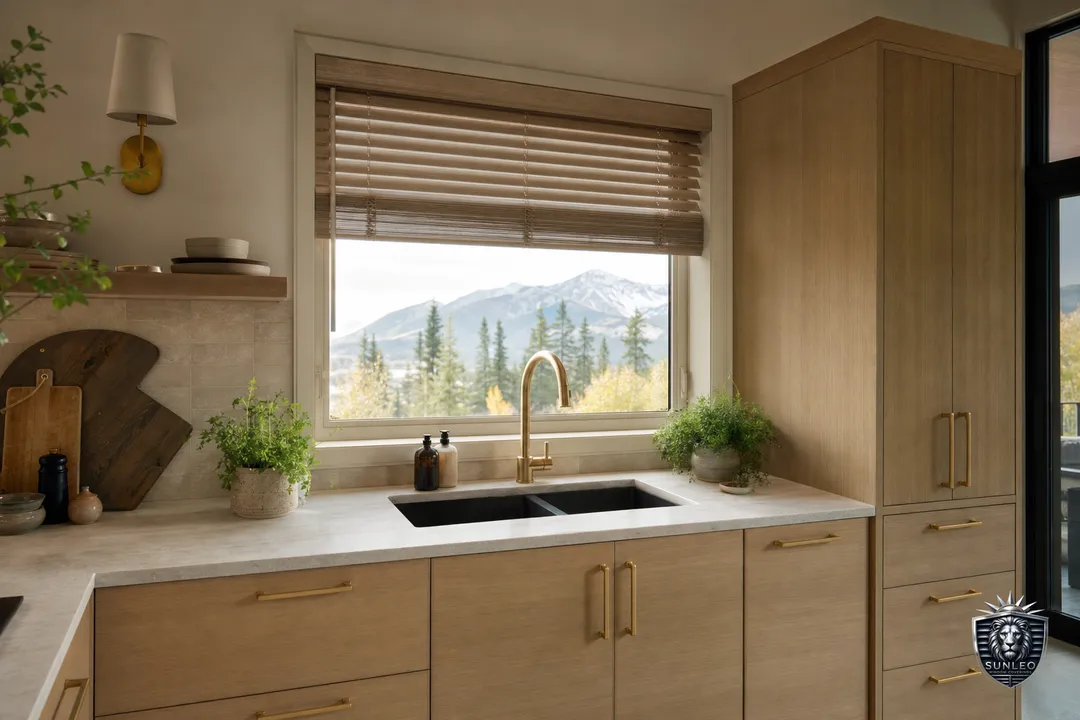
A garden window is one of the most charming — and most awkward — windows to cover. Instead of sitting flat in the wall, this little greenhouse box projects out over your kitchen sink, with a front pane, two angled glass sides, and often a glass top that floods the shelf with light for herbs and houseplants. That projecting, multi-pane shape is exactly what defeats an ordinary blind: there's no flat opening to mount across, the sides face different directions, and a standard fabric shade can't follow the box outward. On top of the geometry, a kitchen garden window lives in steam from the sink, splashes, and water from the plants on its sill — so whatever you hang has to wipe clean and shrug off moisture, not warp or grow mildew like real wood or untreated fabric. Sunleo handles all of this in your home, not a showroom: a specialist measures the box, each angled side and the top opening, and brings real, moisture-friendly samples to hold against your own glass and plants. You get honest advice on which panes actually need covering and a written quote within 48 hours.
Why a garden window needs its own approach
A garden window isn't a flat window with a sill — it's a small projecting box, a mini-greenhouse glued to the wall over your sink. That changes everything about covering it. A typical garden window has a front pane facing the room, two angled glass sides (the 'wings' that make the box), and very often a clear glass top. Because the whole unit pushes outward past the wall, there's no single flat plane to run one blind across, and the shelf inside is usually full of plants, jars or a herb pot that the covering can't crush or sit on. The sides each face a different direction too, so on a south-west Calgary kitchen one wing may be blazing while the other is shaded. All of this means the off-the-shelf answer — one blind, mounted flat, pulled straight down — simply doesn't fit. The realistic solutions are: cover only the front pane and leave the glass sides and top open for light, or fit a separate small blind to each pane so you can shade the box from every angle. Which one is right depends on how much sun the window takes, what's growing on the shelf, and how much privacy you need over the sink — judgments best made looking at the actual window.
Easy-clean, moisture-proof materials matter most
More than any other window in the house, a garden window punishes the wrong material. It's almost always over the kitchen sink, so it lives in a daily mist of steam, cooking grease and water splashes, with extra humidity from the plants and their watering can. Hang real wood Venetian blinds or a fabric Roman shade there and you're inviting warping, water stains and, over time, mildew along the bottom slats. The materials that genuinely belong on a garden window are the ones you can wipe with a damp cloth and forget. Aluminum blinds are the workhorse here — the slats are thin, rust-resistant metal that shrugs off steam and wipes clean in seconds, and they cost less per window than most options. Faux-wood Venetian blinds give you the warm look of timber without the warping; the composite slats are made for humid rooms and wipe down just as easily. A wipeable roller blind in a vinyl-coated fabric is the other moisture-friendly route for the flat front pane. The honest trade-off: aluminum can feel utilitarian and may rattle if a window's open, and faux-wood is heavier and a touch less crisp than real wood. But on a steamy kitchen box, durability beats delicacy every time.
Covering the top and the angled sides
The hardest part of a garden window is rarely the front — it's the glass top and the two angled wings. You have three honest choices, and they trade light against control. The simplest is to cover only the front pane with one blind and leave the sides and top clear; this keeps the maximum daylight pouring onto your plants and is often all a window over a private back-garden sink needs. The most complete is a small, separate blind on each pane — front, both sides, and sometimes the top — so you can tilt or lower each one independently and shade the box from any direction. Slimline aluminum or faux-wood Venetians suit this best because their tilt lets you cut glare without going fully dark, and a narrow blind sits neatly inside each angled section. The glass top is the genuine problem child: it's high, awkward to reach over a sink full of dishes, and many homeowners simply leave it open. Where the top bakes the room or fades a countertop, a small motorized blind earns its place — one tap from a remote or your phone shades it without leaning across the basin. At measurement, Sunleo maps which panes actually need covering so you're not paying to dress glass you'd happily leave clear.
Light, plants and Calgary's climate
A garden window exists to grow things in light, so the goal is controlling sun without starving the shelf — and Calgary makes that a real balancing act. Our high-altitude prairie light is intense and UV-heavy, so a south- or west-facing garden window can scorch tender herbs, fade a wood countertop and overheat the box on a summer afternoon. The low winter sun sits right at eye level and glares straight across the sink for hours. And our Chinooks swing the temperature 20-plus degrees in a day, so the glass on a projecting box runs hot then cold and often beads with condensation — another reason wipe-clean aluminum and faux-wood beat absorbent fabric here. Tilting Venetian or aluminum slats is the most useful tool: angle them to bounce harsh light off the plants while still letting a soft glow through, then close them flat over the sink at night for privacy. A light-filtering roller on the front pane cuts UV and glare while keeping the box bright. The point is to dial light rather than block it — give the plants what they need at midday, tame the worst of the glare, and protect the surfaces underneath, all judged against the direction your particular window faces.
Measuring your garden window in your home
A garden window is exactly the kind of opening that goes wrong with self-measured or ready-made blinds. The box projects an inch or two differently on every install, the side wings sit at an angle that has to be measured pane by pane, the depth has to clear plants and a faucet, and the glass top may or may not be worth covering at all — none of which you can judge from a catalogue. Because Sunleo is mobile-only with no showroom, the measurement and sample selection happen right at your kitchen sink, in your own light, with your plants on the shelf. A specialist measures the front pane, both angled sides and the top, checks how far the box projects and what clears the faucet and pots, and brings moisture-friendly aluminum and faux-wood samples to hold against the actual glass so you can see how they tilt and how they'll wipe clean. You get honest guidance on which panes genuinely need a blind and which to leave open for the plants, then a written, no-obligation quote within 48 hours — with professional installation across Calgary, Airdrie, Okotoks, Cochrane, Chestermere and Strathmore.


