
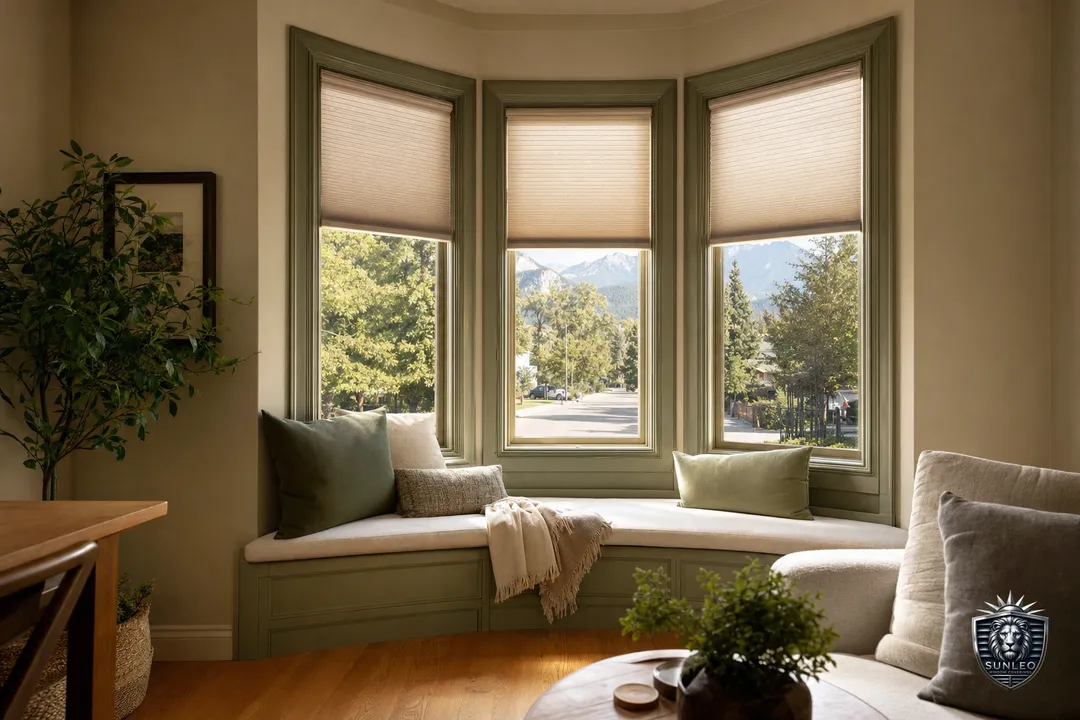
Corner windows are one of the best features a Calgary home can have. Two panes meeting at a 90-degree inside corner pull in light from two directions, frame mountain or skyline views, and make a living room or primary bedroom feel twice as open. They are also one of the trickiest windows to dress, because almost nothing about them is symmetrical once you add a blind.
The core challenge is the inside corner itself. When two windows butt up against each other, the blinds, brackets, and operating hardware on one pane want to occupy the exact space the other pane needs. Mount them carelessly and the two blinds knock into each other, leave an awkward triangle of bare glass at the corner, or stack so deep that they block part of the view they were supposed to frame. On top of that, the two panes often catch very different light through the day, so a setting that looks right on one window can feel too dark or too bright on the other.
The honest answer is that corner windows almost always work best as two individually mounted blinds, not one wraparound treatment. Each pane gets its own blind, sized and positioned so it clears its neighbour, while fabric, colour, and mounting depth are coordinated so the pair reads as a single, intentional design. Below we walk through how Sunleo approaches the corner gap, light and privacy across two panes, Calgary's specific climate demands, and the hardware details that decide whether the finished corner feels seamless or fussy. Every corner is measured in person, because a quarter-inch here genuinely changes which products will fit.
Mount each pane individually and plan for the inside corner gap
The single biggest decision on a corner window is treating it as two blinds, not one. Each pane gets its own blind so both can raise, lower, or rotate without fouling the one beside it. The detail that makes or breaks the look is the inside corner, where the two windows meet. If both blinds are mounted full width, their fabric, side channels, or end caps collide right at that corner. To prevent it, we typically hold one or both blinds back a fraction from the corner edge and stagger which blind sits 'in front' so they pass cleanly. That clearance leaves a slim strip of glass exposed at the very corner. On most rollers and zebra blinds the gap is small and barely noticeable; with bulkier headrails it grows. There is a genuine trade-off here: tighter coverage at the corner means more risk of the blinds touching, while guaranteed clearance means accepting a narrow sliver of light at the join. We measure the exact reveal depth and bracket projection in person so we can promise the blinds clear each other before anything is ordered.
Coordinate light and privacy across two panes facing different directions
A corner window usually faces two directions at once, which means the two panes rarely behave the same. One might take harsh afternoon sun while the other stays shaded, or one may look onto a neighbour's window while the other faces open yard. Because each blind operates independently, you can dial in privacy and glare control pane by pane, which is a real advantage. The catch is keeping them visually consistent. If you run a blackout fabric on the sunny pane and a light-filtering one on the shaded pane, the corner can look mismatched, especially when backlit. The usual solution is the same fabric and colour on both panes, with the light control handled by how far each is lowered or, on zebra blinds, how the dual layers are aligned. Zebra and sheer styles shine here because you can shift from open view to filtered privacy on each pane separately while the fabric stays identical. For bedrooms where you want true darkness on both, matching blackout rollers or honeycomb shades keep the corner uniform while still letting you stagger them slightly to clear the join.
Build for Calgary's UV, Chinooks, and low winter sun
Corner windows collect light from two angles, which is wonderful for ambiance and hard on interiors. Calgary's high-altitude UV is intense, and a corner that faces south or west can fade floors, leather, and artwork faster than a single window would. Zebra blinds with their bands tilted open cut UV and glare while preserving the view, and they are an easy match across both panes. Calgary's other reality is temperature swing. Big corner glazing loses heat fast on a minus-30 January night and can overheat during a sudden Chinook the next week. Honeycomb shades earn their place here: the cellular pockets trap air against the glass and noticeably reduce heat transfer, which matters double on a corner with that much exposed glass. The low winter sun angle is also worth planning for, because it rakes in sideways through corner windows and creates strong glare at eye level on screens and TVs from late morning through afternoon. We position and spec the blinds with that seasonal sun path in mind, so glare control on both panes works in December, not just in June.
Sort out hardware clearance and how you will operate two blinds
On a corner window the operating hardware is exactly where the two panes compete for space. Cords, wands, chains, and motors all sit at one side of each blind, and at the inside corner those controls can end up stacked on top of each other or pinned against the adjoining window frame. We plan the control side of each blind so the operating mechanisms face outward, away from the corner, leaving the join clean. Reach is the other issue. Corner windows often sit behind a sofa, a bed, or a built-in, and stretching across furniture to work the inside blind is awkward. This is where motorization is genuinely practical rather than a luxury: a single remote or app can raise and lower both panes together, so the corner moves as one and you never have to lean into the corner to reach a cord. It is also a safety win in homes with kids or pets, since there are no cords at all. If you prefer manual operation, cordless lift on both panes keeps the corner tidy and child-safe, though you will still reach each blind separately.
Match the look so the corner reads as one view, and measure it properly
Two blinds should feel like one decision. Beyond using the same fabric and colour, the details that sell a seamless corner are matched mounting height, matched headrail depth, and matched stack height so the tops and bottoms line up across the join. When both blinds are raised, their rolls or stacks should sit at the same level; when lowered, their hems should align. Small mismatches read as a mistake even when the fabric is identical. Inside-mount usually gives the cleanest corner because the blinds tuck into each reveal and the frames hide the small gaps, but it demands enough depth, which we confirm by measuring the reveal at top, middle, and bottom of each pane. Outside-mount can cover an awkward corner more fully but the two headrails then meet at the corner and need careful planning to avoid collision. None of this can be guessed from a photo. Sunleo measures every corner window on site, checks reveal depth, squareness, and clearance, and brings real fabric samples so you can see how both panes will look together in your actual light before you commit.


