
Arched, round and specialty-shape windows are one of the hardest things to cover well — and one of the most common in Calgary's newer suburban builds. A half-round transom over a front entry, an eyebrow arch on a two-storey great-room window, a full circle or quarter-round in a stairwell: each is beautiful, lets in a flood of high-altitude Alberta light, and refuses to fit any off-the-shelf blind. The curve is the catch. A standard rectangular shade can't follow it, so the window needs a piece built specifically to its geometry. There are really two paths — a fixed "sunburst" or arch shade that finishes the curve permanently, or an operable shade on the straight section below with the arch handled separately. This page explains the honest trade-offs between fixed and operable options, the specialty shapes we build to, and how the arch gets measured. Sunleo is mobile and template-measures every curve in your home — there's no showroom, and nothing here is off-the-shelf.
Fixed sunburst vs operable: the honest trade-off
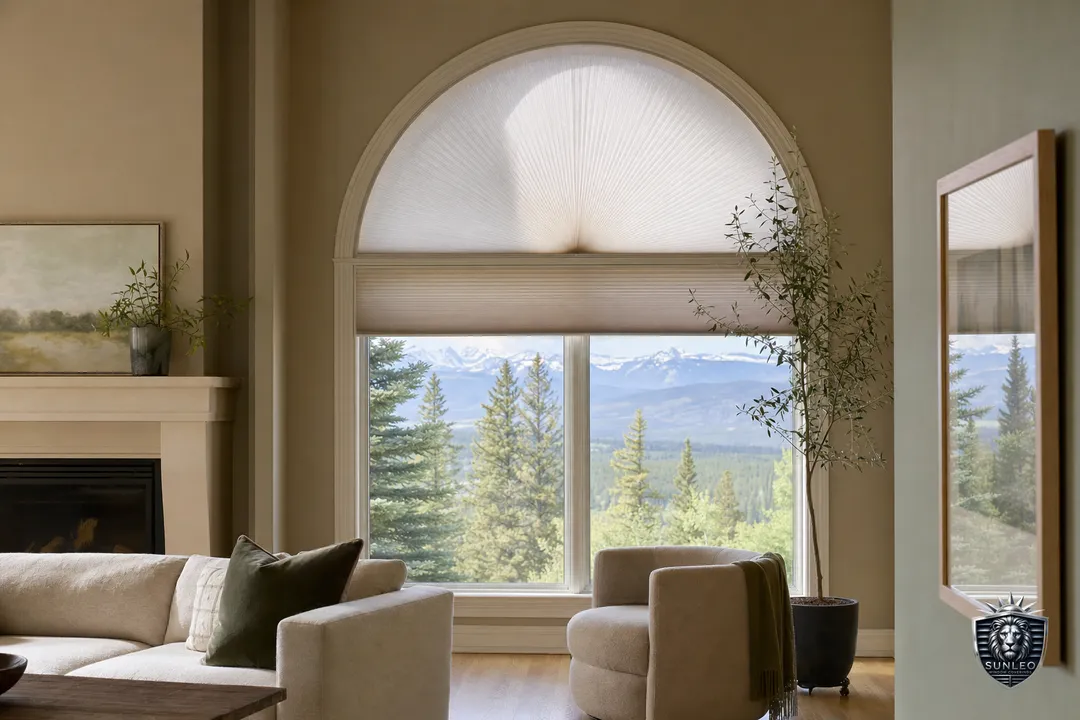
The first decision with any arched window is whether the covering needs to move. Here's the honest engineering reality: making a curved shade raise and lower reliably is difficult and expensive, so the curved part of an arch is almost always a fixed piece. A fixed "sunburst" shade fans pleated fabric out from a central point at the base of the arch, radiating up to the curve — elegant, and it softens light and adds UV protection without any cords or mechanism. A fixed half-round honeycomb shade does the same job with a cleaner, insulating cellular face. Both stay put permanently. The operable control happens on the straight, rectangular section below the spring line (where the curve begins), where a normal shade can raise and lower as usual. For many Calgary feature windows — a tall two-storey arch you'd never reach anyway — a fixed arch on top and an operable shade below is the practical, good-looking answer. If you genuinely need the whole opening to darken, we can also fit a single operable shade across the rectangular portion and leave the arch bare. We'll walk through which approach fits your window, your light and your budget at the in-home visit.
Specialty shapes we build to: half-round, eyebrow, quarter-round and circles
"Arched" covers a whole family of specialty shapes, and each one is built differently. A half-round (perfect arch) is a true semicircle, common above front-entry transoms and great-room windows. An eyebrow arch is a shallow, gentle curve — wider and flatter than a half-round — and is one of the trickiest to template because the radius isn't constant. A quarter-round (quarter circle) curves up on one side only, often where a roofline slopes. Full circles and ovals show up as porthole accents and in stairwells, and angled shapes — triangles, trapezoids and pentagons — appear under vaulted ceilings and gable ends. We build fixed honeycomb and fabric shades for all of these, cut to the exact geometry so they sit flat against the glass with no gaps. The key point is that none of them come in "sizes": a half-round that's a few inches short on the radius is simply the wrong shade, with daylight leaking around the edge. That's why every specialty shape is made to measure from a real on-site template rather than ordered from a chart. If your window combines shapes — say an arch over a rectangle — we treat each part as its own piece.
Why arched windows are made-to-measure — and how we template the curve
You cannot accurately capture a curve with a tape measure and a few numbers, which is exactly why arched windows can't be bought off the shelf. To build a shade that follows the arch, we need the width at the spring line (where the straight sides end and the curve begins), the rise (the height from the spring line to the peak of the arch), and the true shape of the curve itself. For a perfect half-round, the radius is predictable. For eyebrow and irregular arches it isn't — so the reliable method is a physical template: we trace the actual opening onto a paper or card pattern pressed against the glass, capturing every subtle deviation. That template goes to the workshop and the shade is cut to match it. This is hands-on work that has to happen at the window, in your home — there's no way to do it from a showroom or an online form, and a guessed measurement on a custom curve is an expensive mistake because specialty shapes aren't returnable. Sunleo's mobile service is built around exactly this: we come to you, template every arch precisely, show fabric samples against your own glass and light, then send a written quote within 48 hours.
Calgary's newer builds, high arches and harsh sun
Arched windows cluster in Calgary's newer communities — Mahogany, Auburn Bay, Nolan Hill, Evanston, Cochrane and the like — where builders love a half-round transom over the entry and a soaring arched feature window in the great room. Two local realities shape what works on them. First, our high-altitude sun is intense, and these arches are often big and south- or west-facing, so they pour UV onto floors, furniture and artwork. A fixed honeycomb arch or a sunburst shade cuts that UV and heat at the top of the window where it's strongest — genuinely useful for protecting a room. Second, feature arches are usually high up and out of reach, sometimes at the top of a two-storey wall. You're not operating those by hand on a regular basis, which is part of why a fixed arch up top paired with an operable (often motorized) shade below is so common here — the motor handles the reachable section by remote or voice, and the arch quietly does its job year-round. Add Calgary's −30°C winters, and an insulating cellular arch earns its place on a large feature window by trimming heat loss through a lot of glass. We factor all of this in when we visit.


